She sighed in relief as she sent the final email, and looked at the clock on her monitor. 5 54. She had just six minutes to catch the six o clock bus. She looked around carefully to see if the project lead was around. He wasn't. She just had to get out before the loudmouth caught her again and assigned some other task to her. The date was originally at five - she had called and postponed it to seven already. She couldn't wait any longer. She had waited all week to see him, and she really couldn't wait any longer.
She slid out from her cubicle, aiming to visit the restroom before she could catch the bus. But she heard the loudmouth from the general direction of the restroom, and couldn't risk being seen by him. Besides, her watch now showed 5 57. She would have to hurry if she had to catch the six o clock bus. With a silent request to her bladder to cooperate for another hour, she turned and headed for the door.
Her decision turned out to be correct. The buses were just revving up as she reached the parking area, and she only just managed to get into her bus. She sat down thankfully and watched as the buses crawled out of the campus onto the road.
It always seemed like the bus drivers were too fast and rash. But today, their driver seemed to be taking his own time. The bus danced merrily across the humps and potholes, and the driver made no attempt to hurry. She couldn't bear it. She willed him to go faster. But neither the roads, nor the traffic aided that. She just sat and watched the trees go by slowly, painfully slowly.
The traffic built up and slowed to a crawl. The bus driver started steering towards a side road that had lesser traffic, but was so narrow that it was prone to traffic jams. She prayed fervently that he wouldn't take that road, and if he did, that it would be free of traffic. But the driver just had to take the side road, and within a couple of minutes, they were in the midst of a terrible jam. She sighed, and leaned back in her seat. She just had to relax. There was no point worrying - it wouldn't help clear the jam. She closed her eyes. He floated into view in her mind's eye, and she involuntarily smiled. And then she felt the urgency again. When will this blasted jam clear up??
After an unbearable ten minutes, the bus moved again. It cleared the major bottleneck and reached the wide main roads. She sighed with relief. Now only if all the signals were in their favour - she would be there in time. But no, they did have to get stuck at the first major signal. Now they would have to stop at every signal for sure. She looked at her watch, and wished that the traffic would move as quickly as the minute hand in her watch.
After interminable waits at innumerable signals, they reached the final stretch. Just one more signal to go, and then she could alight, and he would be there. It was already fifteen minutes past seven. She was late, and she knew he would already be waiting. The bus stopped at the final signal. She resisted the urge to jump out and run the last few meters - it was far too foolish, and dangerous. The light finally turned green, the bus moved and arrived at her stop. She was already at the door, and was jumping out even before the bus stopped.
She walked quickly to the usual meeting place. Turning the corner, she saw him, a lone figure, standing patiently, watching the traffic go by. As she trotted up to him, he turned, and their eyes met. He smiled.
A wave of warmth swept through her. She relaxed completely in the comfort of his presence. It was worth it, she found herself thinking. The agony, the urgency, the tension, the endless wait - it was all worth it.
Now all she had to do was find a loo.
______________________________________________________
______________________________________________________
Update: What would "He" have been doing all this while, waiting for "Her"? Viky tells you. Read his fabulous story here!
Thursday, February 15, 2007


Tuesday, February 13, 2007
Ruled by machines...
A neighbour dropped in unexpectedly in the evening two days ago. "No cable TV, something wrong - couldn't watch any serial... was feeling bored, so thought of just dropping in to say hi".
My mother's cousin called her last night after ages. "No power since morning - no TV, no radio, no computer... was feeling really bored... so thought I'd just call to say Hi".
My friend called this morning. "Am not able to connect to the internet - don't know what is wrong. That's why I couldn't mail you - so I called you instead."
Now you know why the art of socialization has disappeared.
When machines fail us, we remember human beings.
My mother's cousin called her last night after ages. "No power since morning - no TV, no radio, no computer... was feeling really bored... so thought I'd just call to say Hi".
My friend called this morning. "Am not able to connect to the internet - don't know what is wrong. That's why I couldn't mail you - so I called you instead."
Now you know why the art of socialization has disappeared.
When machines fail us, we remember human beings.
Friday, February 09, 2007
The precious liquid
A little while ago, on the night that the Cauvery tribunal gave its verdict, I went to sleep, only to be awakened at dawn by the sound of water flowing. I woke up to see that the water was overflowing from the overhead tank of a house, a few houses behind ours. They had perhaps forgotten to switch off the pump. There was no way I could contact those people, so all I could do was stand there helplessly, waiting for them to realize what is happening.
As I watched the thick column of water going to waste, I could see in my mind's eye, thousands of farmers, starving and suffering from lack of water. I also saw villagers waiting with rows of empty pots, near the lone tap of the village - waiting for a few drops of that precious liquid to gush out - waiting in vain.
I couldn't go back to sleep until the water stopped flowing.
I woke up to the news that the decision of the Cauvery Tribunal would affect Bangalore too - much of its population would have to face waterless days.
At least now, will people use water wisely? For I have seen how irresponsibly people use, or rather, misuse water.
I can understand if uneducated people waste water - but how about all those educated people around us? How is it that they do not have even a little awareness?
I have seen people turning to talk to me while washing their hands. The tap is open, water is gushing out, and they are turned towards me, explaining something.
I know people who boast that their bath takes 2 hours and 10 buckets of water. Are they so dirty, or are they that huge??
I have seen people washing their cars with water from a pipe.... wasting hundreds of litres of water .... where one bucket of water would suffice to wash one car.
Oh I have even seen Water Supply Tankers going about the roads leaking water all through the roads (like one little cousin of mine had said, "Hey, that lorry is pissing!")
It is not like I haven't tried to tell them. But people more often than not laugh or don't take me seriously. Years ago, While I was walking to school one day with a couple of friends, I saw an open tap in one of those cylindrical community water tanks - so I crossed the road to go and close the tap. I was ragged about that for years to come. I still don't understand why.
When we try to tell people to avoid water wastage, the typical questions are:
* Why? We have no water problem in this area.
* Why? Everybody wastes water anyway, what great difference will it make if I save water.
* Why? Anyway by the time there is real water scarcity, we will anyway be dead. Why take all the trouble now?
I honestly am rendered speechless at this.
And this is the response of educated people. If we try to tell the domestic help at our place not to waste water, she thinks we are stingy. If you cannot explain to educated people, how can you expect this illiterate woman to think of the big picture?
For all my awareness, I hadn't realized that when I wash vessels at the kitchen sink, I keep the tap open more than it is necessary - S showed me how I could wash the same vessel with quarter the amount of water that I use. And now I consciously do that.
This is just about saving water at home. There are many ways in which water can be used wisely for irrigation too. The first technique that comes to my mind is Drip Irrigation. Drip Irrigation is a process in which water is routed through pipes and valves to the fields, and water is released drop by drop to the plant, instead of all the water at one go. This reduces water wastage due to evaporation, and due to water run-off.
I have actually seen this at work in some farms in the Malnad area in Karnataka - and it is amazing how much less water is required compared to ordinary irrigation. I am aware that this might be a slightly expensive method of irrigation, and you might also argue that anyway the water from normal irrigation doesn't really get lost - it goes and settles as ground water or goes back to the atmosphere. True. But that particular farmer's pressing problem of water shortage is solved to a certain extent by drip irrigation, right? And if the farmer has the means and interest to implement this, then great - every drop saved matters.
What does it take to create awareness among people? Not education, for sure. Then what? Maybe they should just step up water rates - levy high prices for each litre of water. At least if people feel the pinch that way, they might come to their senses. Or will they?
Note: Let's not use this platform to debate on whether the Cauvery Tribunal Order is just or not. Thanks.
As I watched the thick column of water going to waste, I could see in my mind's eye, thousands of farmers, starving and suffering from lack of water. I also saw villagers waiting with rows of empty pots, near the lone tap of the village - waiting for a few drops of that precious liquid to gush out - waiting in vain.
I couldn't go back to sleep until the water stopped flowing.
I woke up to the news that the decision of the Cauvery Tribunal would affect Bangalore too - much of its population would have to face waterless days.
At least now, will people use water wisely? For I have seen how irresponsibly people use, or rather, misuse water.
I can understand if uneducated people waste water - but how about all those educated people around us? How is it that they do not have even a little awareness?
I have seen people turning to talk to me while washing their hands. The tap is open, water is gushing out, and they are turned towards me, explaining something.
I know people who boast that their bath takes 2 hours and 10 buckets of water. Are they so dirty, or are they that huge??
I have seen people washing their cars with water from a pipe.... wasting hundreds of litres of water .... where one bucket of water would suffice to wash one car.
Oh I have even seen Water Supply Tankers going about the roads leaking water all through the roads (like one little cousin of mine had said, "Hey, that lorry is pissing!")
It is not like I haven't tried to tell them. But people more often than not laugh or don't take me seriously. Years ago, While I was walking to school one day with a couple of friends, I saw an open tap in one of those cylindrical community water tanks - so I crossed the road to go and close the tap. I was ragged about that for years to come. I still don't understand why.
When we try to tell people to avoid water wastage, the typical questions are:
* Why? We have no water problem in this area.
* Why? Everybody wastes water anyway, what great difference will it make if I save water.
* Why? Anyway by the time there is real water scarcity, we will anyway be dead. Why take all the trouble now?
I honestly am rendered speechless at this.
And this is the response of educated people. If we try to tell the domestic help at our place not to waste water, she thinks we are stingy. If you cannot explain to educated people, how can you expect this illiterate woman to think of the big picture?
For all my awareness, I hadn't realized that when I wash vessels at the kitchen sink, I keep the tap open more than it is necessary - S showed me how I could wash the same vessel with quarter the amount of water that I use. And now I consciously do that.
This is just about saving water at home. There are many ways in which water can be used wisely for irrigation too. The first technique that comes to my mind is Drip Irrigation. Drip Irrigation is a process in which water is routed through pipes and valves to the fields, and water is released drop by drop to the plant, instead of all the water at one go. This reduces water wastage due to evaporation, and due to water run-off.
I have actually seen this at work in some farms in the Malnad area in Karnataka - and it is amazing how much less water is required compared to ordinary irrigation. I am aware that this might be a slightly expensive method of irrigation, and you might also argue that anyway the water from normal irrigation doesn't really get lost - it goes and settles as ground water or goes back to the atmosphere. True. But that particular farmer's pressing problem of water shortage is solved to a certain extent by drip irrigation, right? And if the farmer has the means and interest to implement this, then great - every drop saved matters.
What does it take to create awareness among people? Not education, for sure. Then what? Maybe they should just step up water rates - levy high prices for each litre of water. At least if people feel the pinch that way, they might come to their senses. Or will they?
Note: Let's not use this platform to debate on whether the Cauvery Tribunal Order is just or not. Thanks.
Thursday, February 01, 2007
A request from Arun Kumar Bhardwaj - The Ultrarunner
If you have been reading my blog for a while, you will remember the Ultrarunner Arun Kumar Bhardwaj.
Here is another message from him, which I am reproducing verbatim.
As I post this, he will be running the first marathon. If you, or your organization, would like to support him or sponsor him, please do so.
Here are his contact details once again.
Name: Arun Kumar Bhardwaj
Email : a_runrunrun@yahoo.com
Cell Phone : +91 9213 964 901
Postal Address: Planning Commission, Parliament Street, New Delhi 110001.
Thank you.
Here is another message from him, which I am reproducing verbatim.
Dear Shruti,
By the medium of your blog I would like to inform the people that I am going to undertake The Great Delhi to Shimla Ultramarathon, 375+km within 100 hours (in total that means including all the elapsed time)starting on 1st Feb at 2 PM from the India Gate. We are taking the route Delhi-Chandigarh-Shimla. The last streth of 70 kms gain an height of 1500 meters, i.e. after Kalka. One of my friend is sharing the expenses of the run (I am again without any sponsorship and please let me take to liberty to use your blog to invite any potential sponsor to come with me in this work of great cause to our mother country). After this run I plan to do a Delhi to Goa, 2100km in 21 days.
Cheers,
- Arun
(“You don’t have to be a runner to appreciate it when someone goes beyond the limits. And when someone runs a hundred or a thousand miles one doesn’t have to be a genius to see that the entire human potential has just been expanded. Such examples give people hope and inspiration to change themselves, to be better, and to expect and strive for something higher, something beyond them. Perhaps, they think, if those guys can run a hundred miles then I can do something worthwhile, I can do something good. The world changes more by deeds then by words.” – Tarak Kauff)
As I post this, he will be running the first marathon. If you, or your organization, would like to support him or sponsor him, please do so.
Here are his contact details once again.
Name: Arun Kumar Bhardwaj
Email : a_runrunrun@yahoo.com
Cell Phone : +91 9213 964 901
Postal Address: Planning Commission, Parliament Street, New Delhi 110001.
Thank you.
Wednesday, January 31, 2007
Link Love
There are a million bloggers out there. A few of them are very good, and accordingly, enjoy a large readership. But for every well-known blogger out there, there is an equally good blogger, who for some reason or the other enjoys very little readership.
To set this right, a meme is going around, which asks you to link to those bloggers who you think deserve more readership. I picked it up from Bombay Addict's blog (he has also traced the journey of the meme) - and here I go -
Anitha at Thoughtraker - She does have a dedicated fan following - but I think she deserves much more readership - she writes beautifully.
Usha at Ageless Bonding - Thought-provoking posts about life and people. I never go away from her blog without having gained something.
Raj at Plus Ultra - One of the funniest blogs around.
There are at least half a dozen more I'd like to mention - but either they already have a fair amount of readership, or they don't blog often enough - so I'll stop here.
If you feel likewise about any blogger that you read regularly, please carry this forward. Let's all get to read more good blogs out there!
Also, I have just joined BlogBharti as one of the contributors. What I like about them is that they give preference to the so-called "Z-listers" over "A-listers". Whenever I came across good posts in unknown blogs, I would wish I could link them all on my blog and give them a little publicity - I can conveniently do that now - on BlogBharti.
Most of the blogs of my regular commenters are already on my Blog Radar. But if you come across a good blog, or a good post, on any subject, which you think deserves to be read, please lead me to it. Thank you!
To set this right, a meme is going around, which asks you to link to those bloggers who you think deserve more readership. I picked it up from Bombay Addict's blog (he has also traced the journey of the meme) - and here I go -
Anitha at Thoughtraker - She does have a dedicated fan following - but I think she deserves much more readership - she writes beautifully.
Usha at Ageless Bonding - Thought-provoking posts about life and people. I never go away from her blog without having gained something.
Raj at Plus Ultra - One of the funniest blogs around.
There are at least half a dozen more I'd like to mention - but either they already have a fair amount of readership, or they don't blog often enough - so I'll stop here.
If you feel likewise about any blogger that you read regularly, please carry this forward. Let's all get to read more good blogs out there!
Also, I have just joined BlogBharti as one of the contributors. What I like about them is that they give preference to the so-called "Z-listers" over "A-listers". Whenever I came across good posts in unknown blogs, I would wish I could link them all on my blog and give them a little publicity - I can conveniently do that now - on BlogBharti.
Most of the blogs of my regular commenters are already on my Blog Radar. But if you come across a good blog, or a good post, on any subject, which you think deserves to be read, please lead me to it. Thank you!
Friday, January 26, 2007
PG Aunty
During the 16 months that I worked in Mumbai, I lived as a paying guest(pg). Many people had advised me against going for a pg accommodation, citing restrictions and lack of privacy. But when I did go house-hunting and found this house with a convenient room and a nice Sikh lady in charge, I jumped at it. I decided that I would need company in my first few days in the big bad city, and then later, if I felt that the pg cramped my style, I could always move to a flat. Besides, I didn't plan to live in Mumbai for too long. So I moved in. [I did try flat-hunting after a month or so, but at every stage I evaluated the merits and demerits of the flat and the pg I lived in, and eventually gave up the idea of moving into a flat of my own].
PG Aunty, as we all referred to her, was a very interesting woman. Very fat, with thinning hair, she had a perpetually worried look on her face. With five daughters, three of them yet to be married, she was forced to take in paying guests after her husband's business suffered severe losses. With a large house with many rooms, she had quite a few girls rooming with her. Add to them, the three daughters of her own, and a stern silver-haired silver-bearded husband, she had her hands full.
Her schedule was remarkable. We girls left home for work at different times in the morning - The two girls who were my colleagues, and I, were the first to leave. We had to catch our bus at eight in the morning. Aunty would rise at around seven, and go straight to the kitchen to start the food manufacturing for the day. She had a four-burner stove, which she utilized completely. On the back left burner, the tea boiled. On the back right burner cooked the vegetable curry of the day. On the front left burner was a tava on which she cooked chapatis for us to take as packed lunch, and on the front right burner was another tava on which she cooked thick parathas. All simultaneously.
She had two lumps of doughs - one for parathas and one for chapatis, and her hands never stopped working. She would pluck out a fistful of dough from the dough, and with three - just three (I counted) twists of the dough, it would become this perfectly spherical ball. She would then roll it out quickly, into, needless to say, a perfectly round chapati/paratha, and then it would fly, as if on its own to one of the two tavas on the stove. Oil would be poured on the chapati/paratha (this is where I would avert my eyes). A couple of quick turns and twists, and the chapati would come out of the tava and get wrapped up in aluminum foil and go and sit in our lunch boxes, and the paratha would fly into our waiting plates. In the milliseconds that she had between making these chapatis and parathas, she would add the masala to the curry or sugar to the tea, and stir the contents of those vessels. And by the time we came back for more parathas, the ready curry would have magically found its way into our boxes, the box would be packed and ready for us to take. How many times have we tried to tell her that we would do the packing ourselves, Aunty, please don't bother - but no. It would somehow get ready, as if she had a magic wand. And in all those mornings, during all those months, she ensured that we were never late. Only once did we miss our bus by a whisker - and that was because Aunty couldn't wake up in the morning because it was too cold (by Mumbai standards).
I can't speak enough about her cooking. It wasn't gourmet fare, but she was a good cook. Cooking for so many people, thrice a day, everyday, is far from easy. And she did the best that she could. Yes, it was Punjabi food most of the time - but I did not complain. I am such a foodie that I don't mind any cuisine, as long as it is good. I did miss South Indian food sometimes, and once, when I missed Saaru too much, I bought a packet of MTR Rasam powder and made Saaru for everybody that night. She also used to make something called Sindhi kadhi, which tasted remarkably like our huLi - so I enjoyed that quite a bit. Sometimes as a "special treat" to me, she would make Idli - sambar. The idlis were like stones and the sambar was not at all like sambar - but anyway I told her that I enjoyed it - I couldn't bear to see disappointment on her enthusiastic, eager-to-please face.
But she was the authority in Punjabi cuisine. She made some of the best parathas, and some great curries. These had too much oil in them sometimes, and part of my lunch ritual at office was pouring out the oil floating on top of the curry - but it was delicious nonetheless. She made great Baingan ka bharta and stuffed brinjal. Her potato fry was also very tasty. Her Khichdi was delicious. It was kind of too gooey for my liking, but I loved the taste. Her masterpieces were the Methi Malai Matar and the most exquisite Dal Ka Halwa. Strangely enough, her Carrot Halwa was uneatable, but if you ate her Dal Ka Halwa, you would forgive her for anything!
Sometimes she would turn fiercely money-minded. If we took extra curds with our dinner three days in a row, her eagle eye would notice it and say, "If you want so much curds, you should pay fifty rupees extra each month!" On the other hand, when I was down with a bad stomach upset, she made bland food and lassi for me, apart from the usual food for everybody else, and nearly hand-fed me everyday until I got better.
She often joked and laughed with us, and told us her problems. She in turn wanted to know everything about us - especially whether we had boyfriends. Sometimes the child in her would come out and she would indulge in playing pranks upon us. She also occasionally conspired with us against her husband who tried to be very strict with us. Uncle had set 11 pm as the curfew for the pgs, but if we pleaded with Aunty to relax it for "jusssst one day", she would turn a blind eye and even distract her husband when we let ourselves softly into the house after 11 pm. Uncle always wanted to watch Aaj Tak channel on TV. So when we wanted to watch something else, we would switch on our channel and then "lose" the remote (The TV was slightly conked out - the channel change button on the TV set did not work). We would then "find" the remote and hand it back to Uncle once our programme ended. Aunty knew all this, but she just smiled and said nothing.
She was extremely sensitive. She would take offhand remarks to heart and worry about the layers and layers of meanings in that comment. It worked the other way too. She was very conscious that she would hurt one of us inadvertently.
Once she came to me early in the morning and told me about her expenses and that they had to pay the daughters' college and school fees that month and they were out of money and all that. Just when I was wondering where it was all leading to, she said, "I wouldn't have bothered you otherwise, but could you please pay your rent for this month quickly?" I was surprised - I had already paid the rent for the month. I reminded her, but she was confused. I then jogged her memory, told her that I had brought the money to the kitchen, but her hands had been busy and so she had asked me to keep it under the sugar box. Enlightenment dawned on her face and she grew extremely apologetic. "How could I do this to you? You are always the first one who pays the rent, and always within the third of the month - and I doubted you of all the people... " She apologized until I was worried I would get late for office. I said "Aunty, it is ok, such things do happen...." But she called me even at office - twice - to apologize, "Bura mat maan-na, Shrooti, please, kya boldiya maine, kya sochegi tu mere baare mein..."... I finally had to tell her "Aunty, aap mujhe sharminda kar rahe hai"... She stopped, but she was extra nice to me for the next week!
She wasn't in town when I left Mumbai. Her daughter who lived in Indore was not well, and she had gone to visit her. It was good in a way, because she would have become "senti", and I, being the softie that I am, would no doubt have cried.
I still call her sometimes, and I once even wrote a letter to her in Hindi - it's very touching to see how thrilled she always is to hear from "her girls", as she calls us.
Good times and bad, I have had them all in Mumbai - but there is no doubt that by and large, my stay was comfortable and convenient - and a lot of the credit for that goes to PG Aunty!
PG Aunty, as we all referred to her, was a very interesting woman. Very fat, with thinning hair, she had a perpetually worried look on her face. With five daughters, three of them yet to be married, she was forced to take in paying guests after her husband's business suffered severe losses. With a large house with many rooms, she had quite a few girls rooming with her. Add to them, the three daughters of her own, and a stern silver-haired silver-bearded husband, she had her hands full.
Her schedule was remarkable. We girls left home for work at different times in the morning - The two girls who were my colleagues, and I, were the first to leave. We had to catch our bus at eight in the morning. Aunty would rise at around seven, and go straight to the kitchen to start the food manufacturing for the day. She had a four-burner stove, which she utilized completely. On the back left burner, the tea boiled. On the back right burner cooked the vegetable curry of the day. On the front left burner was a tava on which she cooked chapatis for us to take as packed lunch, and on the front right burner was another tava on which she cooked thick parathas. All simultaneously.
She had two lumps of doughs - one for parathas and one for chapatis, and her hands never stopped working. She would pluck out a fistful of dough from the dough, and with three - just three (I counted) twists of the dough, it would become this perfectly spherical ball. She would then roll it out quickly, into, needless to say, a perfectly round chapati/paratha, and then it would fly, as if on its own to one of the two tavas on the stove. Oil would be poured on the chapati/paratha (this is where I would avert my eyes). A couple of quick turns and twists, and the chapati would come out of the tava and get wrapped up in aluminum foil and go and sit in our lunch boxes, and the paratha would fly into our waiting plates. In the milliseconds that she had between making these chapatis and parathas, she would add the masala to the curry or sugar to the tea, and stir the contents of those vessels. And by the time we came back for more parathas, the ready curry would have magically found its way into our boxes, the box would be packed and ready for us to take. How many times have we tried to tell her that we would do the packing ourselves, Aunty, please don't bother - but no. It would somehow get ready, as if she had a magic wand. And in all those mornings, during all those months, she ensured that we were never late. Only once did we miss our bus by a whisker - and that was because Aunty couldn't wake up in the morning because it was too cold (by Mumbai standards).
I can't speak enough about her cooking. It wasn't gourmet fare, but she was a good cook. Cooking for so many people, thrice a day, everyday, is far from easy. And she did the best that she could. Yes, it was Punjabi food most of the time - but I did not complain. I am such a foodie that I don't mind any cuisine, as long as it is good. I did miss South Indian food sometimes, and once, when I missed Saaru too much, I bought a packet of MTR Rasam powder and made Saaru for everybody that night. She also used to make something called Sindhi kadhi, which tasted remarkably like our huLi - so I enjoyed that quite a bit. Sometimes as a "special treat" to me, she would make Idli - sambar. The idlis were like stones and the sambar was not at all like sambar - but anyway I told her that I enjoyed it - I couldn't bear to see disappointment on her enthusiastic, eager-to-please face.
But she was the authority in Punjabi cuisine. She made some of the best parathas, and some great curries. These had too much oil in them sometimes, and part of my lunch ritual at office was pouring out the oil floating on top of the curry - but it was delicious nonetheless. She made great Baingan ka bharta and stuffed brinjal. Her potato fry was also very tasty. Her Khichdi was delicious. It was kind of too gooey for my liking, but I loved the taste. Her masterpieces were the Methi Malai Matar and the most exquisite Dal Ka Halwa. Strangely enough, her Carrot Halwa was uneatable, but if you ate her Dal Ka Halwa, you would forgive her for anything!
Sometimes she would turn fiercely money-minded. If we took extra curds with our dinner three days in a row, her eagle eye would notice it and say, "If you want so much curds, you should pay fifty rupees extra each month!" On the other hand, when I was down with a bad stomach upset, she made bland food and lassi for me, apart from the usual food for everybody else, and nearly hand-fed me everyday until I got better.
She often joked and laughed with us, and told us her problems. She in turn wanted to know everything about us - especially whether we had boyfriends. Sometimes the child in her would come out and she would indulge in playing pranks upon us. She also occasionally conspired with us against her husband who tried to be very strict with us. Uncle had set 11 pm as the curfew for the pgs, but if we pleaded with Aunty to relax it for "jusssst one day", she would turn a blind eye and even distract her husband when we let ourselves softly into the house after 11 pm. Uncle always wanted to watch Aaj Tak channel on TV. So when we wanted to watch something else, we would switch on our channel and then "lose" the remote (The TV was slightly conked out - the channel change button on the TV set did not work). We would then "find" the remote and hand it back to Uncle once our programme ended. Aunty knew all this, but she just smiled and said nothing.
She was extremely sensitive. She would take offhand remarks to heart and worry about the layers and layers of meanings in that comment. It worked the other way too. She was very conscious that she would hurt one of us inadvertently.
Once she came to me early in the morning and told me about her expenses and that they had to pay the daughters' college and school fees that month and they were out of money and all that. Just when I was wondering where it was all leading to, she said, "I wouldn't have bothered you otherwise, but could you please pay your rent for this month quickly?" I was surprised - I had already paid the rent for the month. I reminded her, but she was confused. I then jogged her memory, told her that I had brought the money to the kitchen, but her hands had been busy and so she had asked me to keep it under the sugar box. Enlightenment dawned on her face and she grew extremely apologetic. "How could I do this to you? You are always the first one who pays the rent, and always within the third of the month - and I doubted you of all the people... " She apologized until I was worried I would get late for office. I said "Aunty, it is ok, such things do happen...." But she called me even at office - twice - to apologize, "Bura mat maan-na, Shrooti, please, kya boldiya maine, kya sochegi tu mere baare mein..."... I finally had to tell her "Aunty, aap mujhe sharminda kar rahe hai"... She stopped, but she was extra nice to me for the next week!
She wasn't in town when I left Mumbai. Her daughter who lived in Indore was not well, and she had gone to visit her. It was good in a way, because she would have become "senti", and I, being the softie that I am, would no doubt have cried.
I still call her sometimes, and I once even wrote a letter to her in Hindi - it's very touching to see how thrilled she always is to hear from "her girls", as she calls us.
Good times and bad, I have had them all in Mumbai - but there is no doubt that by and large, my stay was comfortable and convenient - and a lot of the credit for that goes to PG Aunty!
Wednesday, January 24, 2007
Rising for the National Anthem - below your dignity?
Republic Day is round the corner and this brings me to a topic that I have often wondered about.
I am sure I am not the only one to have noticed it - but why do we Indians hesitate to stand up when the National Anthem is playing? The last time I remember an entire gathering rising at once when the National Anthem was sung/played was at school.
The first time I noticed this phenomenon was years ago, when I visited Delhi with my cousins. We were watching the Light and Sound show at the Red Fort. The show ended, and the National Anthem was played. The audience sat rooted to their seats. My then eleven-year-old cousin looked around in surprise, then stood up promptly, ramrod straight. We quickly did the same. Since we were somewhere in the front, the rest of the audience followed our example, and slowly, everybody rose. Did they really need an eleven-year-old to tell them to rise when the National Anthem is played?
I remember a campaign from a while ago. I remember watching it in theaters before the movie began - I don't quite remember having watched it on TV. A wizened old man is sitting on the footpath (at a shoeshine stand?) along with a number of young boys. The old man tunes the radio with knobby fingers. The national anthem starts playing. The young kids sit where they are. But this old man struggles hard to get up, and then stands up - on his only leg. It starts raining then - and the picture is of the very old one-legged man standing, chin up, in the rain, as the anthem plays in the background. The other kids look at him, and stand up too. It is followed by the message "Respect your national anthem" or something like that. Even then, I thought - do you actually need an ad to tell you to rise when the national anthem is playing?
I have seen this attitude - this reluctance to rise, everywhere. For example, in Mumbai, the anthem is played before the movie begins. Only half of the hall rises immediately - the others do follow suit, but only after embarrassed looks at each other. And some people remain seated throughout, one leg over the other, munching their pop-corn.
Why are we expected to rise when the National Anthem is played? For the same reason that we rise when a senior person enters a room - as a mark of respect. Is it below our dignity to display respect for our Anthem?
I don't mean to say that people who don't rise are unpatriotic or that they don't respect the anthem. For that matter, just standing up for the anthem doesn't reflect your patriotism. But it is just a gesture of respect. And I don't think these people mean any disrespect. But then why the hesitation in standing up? Why the embarrassment? Why the sheepish smiles? In fact, when only one person in a group rises, I have seen him being ribbed and teased. I am sure he will not rise the next time.
I have no idea what the scene is in other countries. I doubt that this is the case there. If it is not, please enlighten me, all you well-travelled folks out there. In fact, I wouldn't be surprised if you tell me stories about an Indian in the US rising immediately if "The Star-spangled banner" is played, and remaining seated when "Jana Gana Mana" is played.
On the lighter side, what do you do when it is being played on TV and you are sitting at home, alone or with family? Do you change channels? Or do you rise? Just curious!
I am sure I am not the only one to have noticed it - but why do we Indians hesitate to stand up when the National Anthem is playing? The last time I remember an entire gathering rising at once when the National Anthem was sung/played was at school.
The first time I noticed this phenomenon was years ago, when I visited Delhi with my cousins. We were watching the Light and Sound show at the Red Fort. The show ended, and the National Anthem was played. The audience sat rooted to their seats. My then eleven-year-old cousin looked around in surprise, then stood up promptly, ramrod straight. We quickly did the same. Since we were somewhere in the front, the rest of the audience followed our example, and slowly, everybody rose. Did they really need an eleven-year-old to tell them to rise when the National Anthem is played?
I remember a campaign from a while ago. I remember watching it in theaters before the movie began - I don't quite remember having watched it on TV. A wizened old man is sitting on the footpath (at a shoeshine stand?) along with a number of young boys. The old man tunes the radio with knobby fingers. The national anthem starts playing. The young kids sit where they are. But this old man struggles hard to get up, and then stands up - on his only leg. It starts raining then - and the picture is of the very old one-legged man standing, chin up, in the rain, as the anthem plays in the background. The other kids look at him, and stand up too. It is followed by the message "Respect your national anthem" or something like that. Even then, I thought - do you actually need an ad to tell you to rise when the national anthem is playing?
I have seen this attitude - this reluctance to rise, everywhere. For example, in Mumbai, the anthem is played before the movie begins. Only half of the hall rises immediately - the others do follow suit, but only after embarrassed looks at each other. And some people remain seated throughout, one leg over the other, munching their pop-corn.
Why are we expected to rise when the National Anthem is played? For the same reason that we rise when a senior person enters a room - as a mark of respect. Is it below our dignity to display respect for our Anthem?
I don't mean to say that people who don't rise are unpatriotic or that they don't respect the anthem. For that matter, just standing up for the anthem doesn't reflect your patriotism. But it is just a gesture of respect. And I don't think these people mean any disrespect. But then why the hesitation in standing up? Why the embarrassment? Why the sheepish smiles? In fact, when only one person in a group rises, I have seen him being ribbed and teased. I am sure he will not rise the next time.
I have no idea what the scene is in other countries. I doubt that this is the case there. If it is not, please enlighten me, all you well-travelled folks out there. In fact, I wouldn't be surprised if you tell me stories about an Indian in the US rising immediately if "The Star-spangled banner" is played, and remaining seated when "Jana Gana Mana" is played.
On the lighter side, what do you do when it is being played on TV and you are sitting at home, alone or with family? Do you change channels? Or do you rise? Just curious!
Saturday, January 20, 2007
Life, memories, and contemplation.
[Warning: I wouldn't recommend this post to you if you are in a depressed frame of mind.]
Many times, I wonder - Why do we behave the way we do? Why do we do the things we do? How do we learn to say the things that we say?
When she died, even before I could digest the fact that she was no more, even when I was reeling under the shock of the terrible news, I found myself speaking about her in the past tense. "She was so full of life, how can she be dead?" I said. And realized even in that state, how fragile life is - how soon one can change from being spoken of in the present tense to the past tense.
As I tried to grapple with the reality that I would no more see and hear her in the tangible sense, I found myself clinging to things which were her - intangible or semi-tangible. Or things that had her mark. I didn't delete her mails when cleaning up my inbox, I saved her last message in Orkut. I looked at her photo for a long time - observed how her hair falls around her face, how wide and spontaneous her smile is. I find myself thinking about the lac bangles she got for me from her trip to Gujarat. They are in my mom's house. I know I had wrapped them up and kept them carefully - they are very delicate - but are they safe enough? I have this urge to pop down to mom's place immediately and keep the bangles in a safer place. I know I will never wear them again. But I also know that I will treasure them forever.
Does that mean I didn't care about her when she was alive? Didn't I delete her forwarded mails without a second thought? Did I look at her photo for a second longer than was necessary to recognize her? Other than the fact that she had cared enough to bring me those pretty lac bangles, were they so precious to me when she was alive? Then why does this happen the moment the person dies? Is it just that you see the person in those things, in those objects, and feel - she is not there any more, let me at least keep these close to my heart..?
But what is death? When a person ceases to exist, we call it death. But what is existence? Is it just that she is not around any longer - we will not hear her speak any more, we will not hear her laughter any more, I cannot put my arm around her any more?
But what about her image that exists in all of us? That image that has no death? It might fade a little with time - ten years from now, I might have difficulty remembering how exactly she laughed, how tall she was - but her image will never disappear for as long as we live, will it? Doesn't she still live on, in that sense?
There is a very touching and poignant Raccoon episode in Calvin and Hobbes. Calvin finds a wounded baby raccoon and brings it home, hoping to nurse it back to health. But in the course of the night, the raccoon dies. When he hears about it in the morning, Calvin bawls his lungs out. His father tries to comfort him, and Calvin says, "I'm crying because out there he's gone, but he's not gone inside me". [This particular strip is here, and the entire Raccoon episode here.(A must read for Calvin fans)].
Could it have been expressed more beautifully?
Then that means death is not when a person ceases to exist. It is just when the physical form of a person ceases to exist. So what is the right word for "death" in the physical sense?
Questions as usual... and the answers, elusive as always...
But life goes on.
"She" is a much-loved cousin who passed away in a road accident ten days ago. She was very active, cheerful, and lived every moment fully. We'll all miss her.
Many times, I wonder - Why do we behave the way we do? Why do we do the things we do? How do we learn to say the things that we say?
When she died, even before I could digest the fact that she was no more, even when I was reeling under the shock of the terrible news, I found myself speaking about her in the past tense. "She was so full of life, how can she be dead?" I said. And realized even in that state, how fragile life is - how soon one can change from being spoken of in the present tense to the past tense.
As I tried to grapple with the reality that I would no more see and hear her in the tangible sense, I found myself clinging to things which were her - intangible or semi-tangible. Or things that had her mark. I didn't delete her mails when cleaning up my inbox, I saved her last message in Orkut. I looked at her photo for a long time - observed how her hair falls around her face, how wide and spontaneous her smile is. I find myself thinking about the lac bangles she got for me from her trip to Gujarat. They are in my mom's house. I know I had wrapped them up and kept them carefully - they are very delicate - but are they safe enough? I have this urge to pop down to mom's place immediately and keep the bangles in a safer place. I know I will never wear them again. But I also know that I will treasure them forever.
Does that mean I didn't care about her when she was alive? Didn't I delete her forwarded mails without a second thought? Did I look at her photo for a second longer than was necessary to recognize her? Other than the fact that she had cared enough to bring me those pretty lac bangles, were they so precious to me when she was alive? Then why does this happen the moment the person dies? Is it just that you see the person in those things, in those objects, and feel - she is not there any more, let me at least keep these close to my heart..?
But what is death? When a person ceases to exist, we call it death. But what is existence? Is it just that she is not around any longer - we will not hear her speak any more, we will not hear her laughter any more, I cannot put my arm around her any more?
But what about her image that exists in all of us? That image that has no death? It might fade a little with time - ten years from now, I might have difficulty remembering how exactly she laughed, how tall she was - but her image will never disappear for as long as we live, will it? Doesn't she still live on, in that sense?
There is a very touching and poignant Raccoon episode in Calvin and Hobbes. Calvin finds a wounded baby raccoon and brings it home, hoping to nurse it back to health. But in the course of the night, the raccoon dies. When he hears about it in the morning, Calvin bawls his lungs out. His father tries to comfort him, and Calvin says, "I'm crying because out there he's gone, but he's not gone inside me". [This particular strip is here, and the entire Raccoon episode here.(A must read for Calvin fans)].
Could it have been expressed more beautifully?
Then that means death is not when a person ceases to exist. It is just when the physical form of a person ceases to exist. So what is the right word for "death" in the physical sense?
Questions as usual... and the answers, elusive as always...
But life goes on.
"She" is a much-loved cousin who passed away in a road accident ten days ago. She was very active, cheerful, and lived every moment fully. We'll all miss her.
Wednesday, January 17, 2007
Lakes of Mysore - photographs - continued
The previous post had snaps from Kukkarahalli Kere. Here are snaps of Karanji Kere.
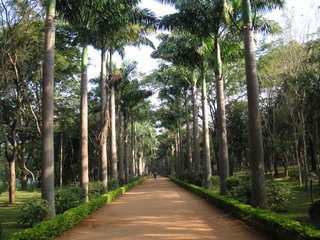
The main pathway at the entrance, leading to Karanji Kere.
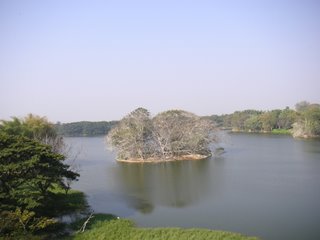
Karanji Kere as seen from the watch-tower. And if you are wondering why the tree is white - those are bird droppings.
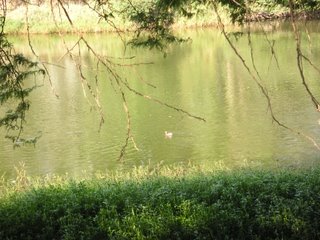
I find myself wishing that I were this duck - floating blissfully in the cool waters of Karanji Kere.
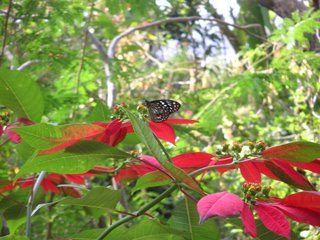
A butterfly in the butterfly park, Karanji Kere.
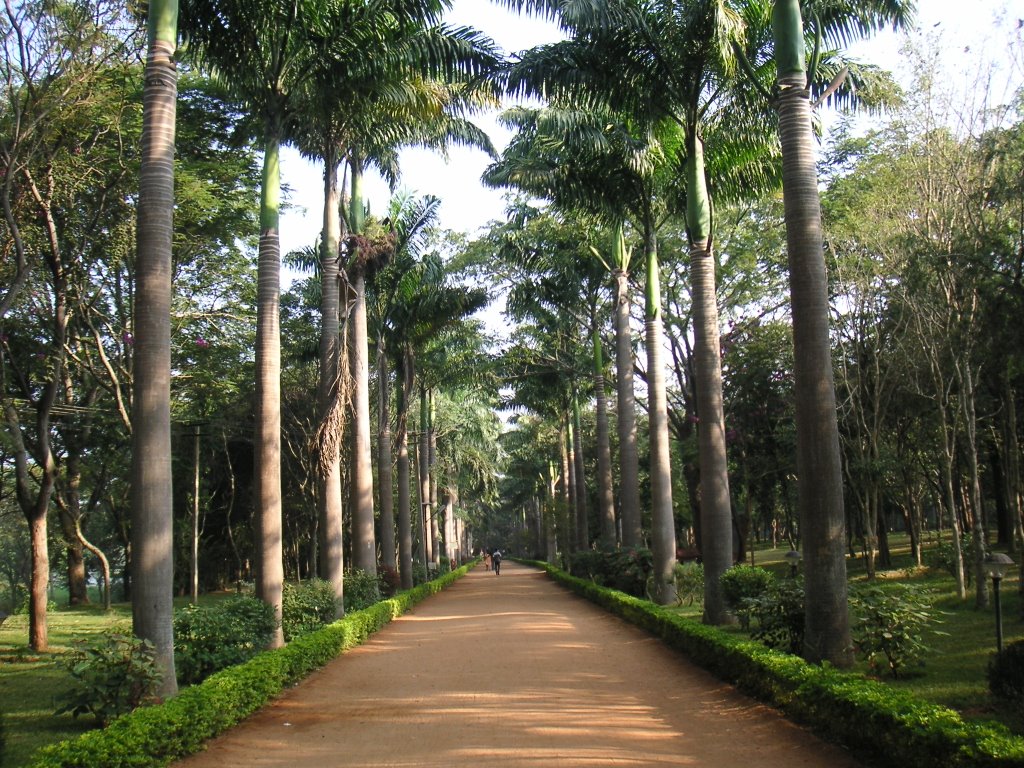
The main pathway at the entrance, leading to Karanji Kere.
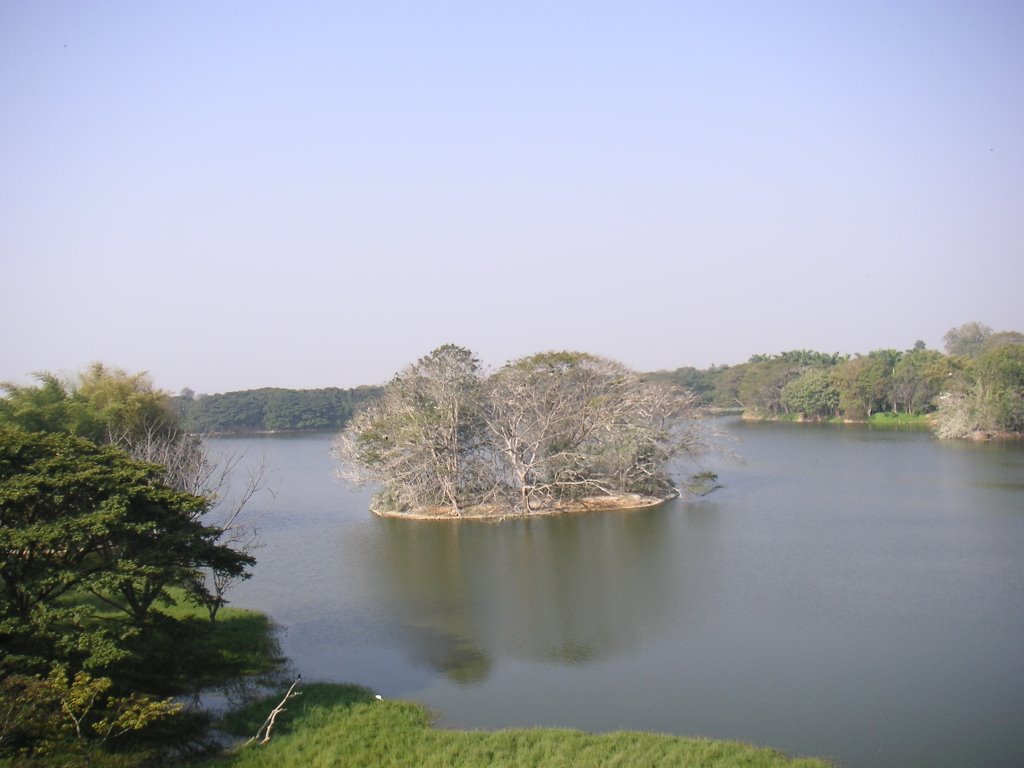
Karanji Kere as seen from the watch-tower. And if you are wondering why the tree is white - those are bird droppings.
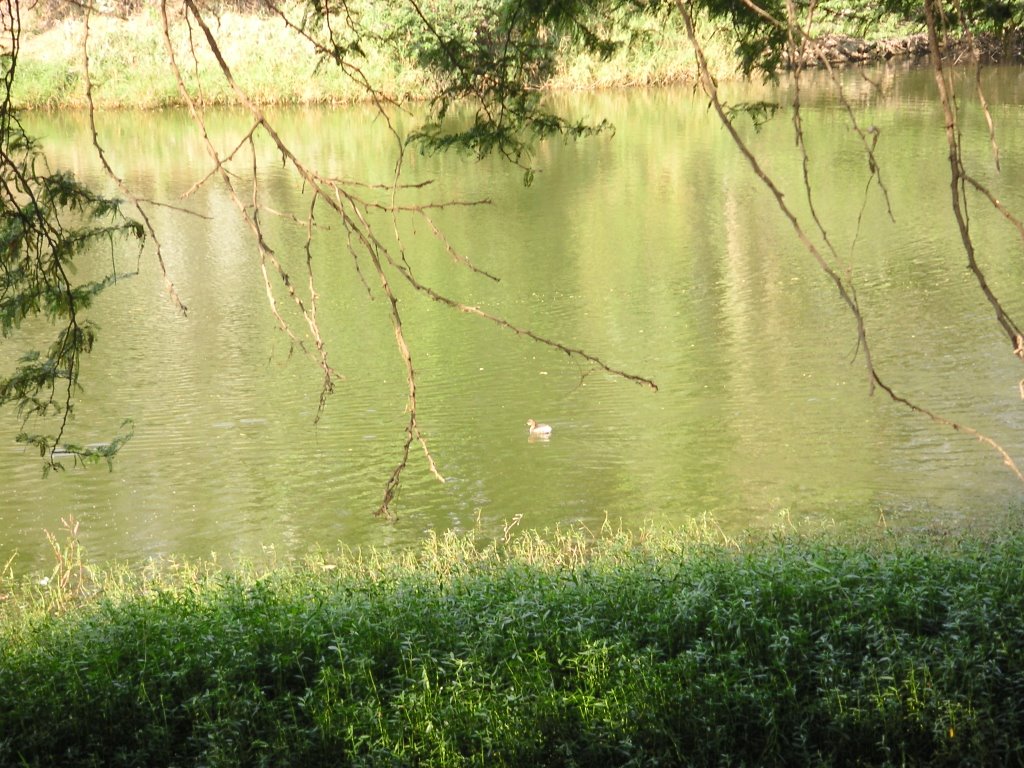
I find myself wishing that I were this duck - floating blissfully in the cool waters of Karanji Kere.

A butterfly in the butterfly park, Karanji Kere.
Wednesday, January 10, 2007
Lakes of Mysore - photographs.
We were in Mysore last weekend. I have already written about how cool I think Mysore is, and I don't need to reiterate that I had loads of fun.
This time, I went determined to visit all the three lakes in Mysore. Kukkarahalli kere, of course, being about a quarter of a kilometer from my grandparents' house, I visit every time I go. But I hadn't visited Lingambudhi kere and Karanji Kere.
So, I did it - visited all three lakes, and did a lot of leisurely walking and birdwatching. We saw pelicans, painted storks, cormorants, egrets, herons, moor hens, kingfishers, bee-eaters, woodpeckers, snake birds, ducks, teals, and many more birds that I cannot even name.
Kukkarahalli - I have already written about it here, was perfect as usual. Lingambudhi kere is good, still quite undeveloped... but has its own beauty. We witnessed a marvellous sunset here. Unfortunately, I didn't have my camera with me that day. I had heard a lot about Karanji Kere, and I was not disappointed. They have developed the surroundings very well, and it is a treat to walk around the place. The view from the watch tower is great - you don't feel like coming back down. There is also a butterfly park, on a little island, which is lovely, well worth the long walk to the place.
I will not write any more, but will just leave you with these photographs.
Kukkarahalli kere, with Chamundi Betta in the background.
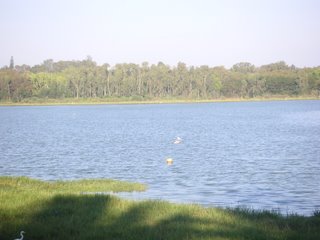
A pelican swimming meditatively in the waters, Kukkarahalli Kere.
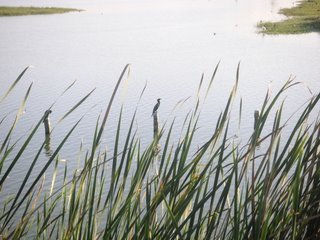
A cormorant in the reeds, Kukkarahalli Kere.
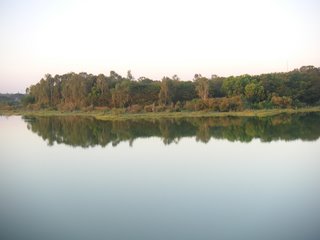
Tranquility, Kukkarahalli Kere.
The rest in the next.
This time, I went determined to visit all the three lakes in Mysore. Kukkarahalli kere, of course, being about a quarter of a kilometer from my grandparents' house, I visit every time I go. But I hadn't visited Lingambudhi kere and Karanji Kere.
So, I did it - visited all three lakes, and did a lot of leisurely walking and birdwatching. We saw pelicans, painted storks, cormorants, egrets, herons, moor hens, kingfishers, bee-eaters, woodpeckers, snake birds, ducks, teals, and many more birds that I cannot even name.
Kukkarahalli - I have already written about it here, was perfect as usual. Lingambudhi kere is good, still quite undeveloped... but has its own beauty. We witnessed a marvellous sunset here. Unfortunately, I didn't have my camera with me that day. I had heard a lot about Karanji Kere, and I was not disappointed. They have developed the surroundings very well, and it is a treat to walk around the place. The view from the watch tower is great - you don't feel like coming back down. There is also a butterfly park, on a little island, which is lovely, well worth the long walk to the place.
I will not write any more, but will just leave you with these photographs.

Kukkarahalli kere, with Chamundi Betta in the background.
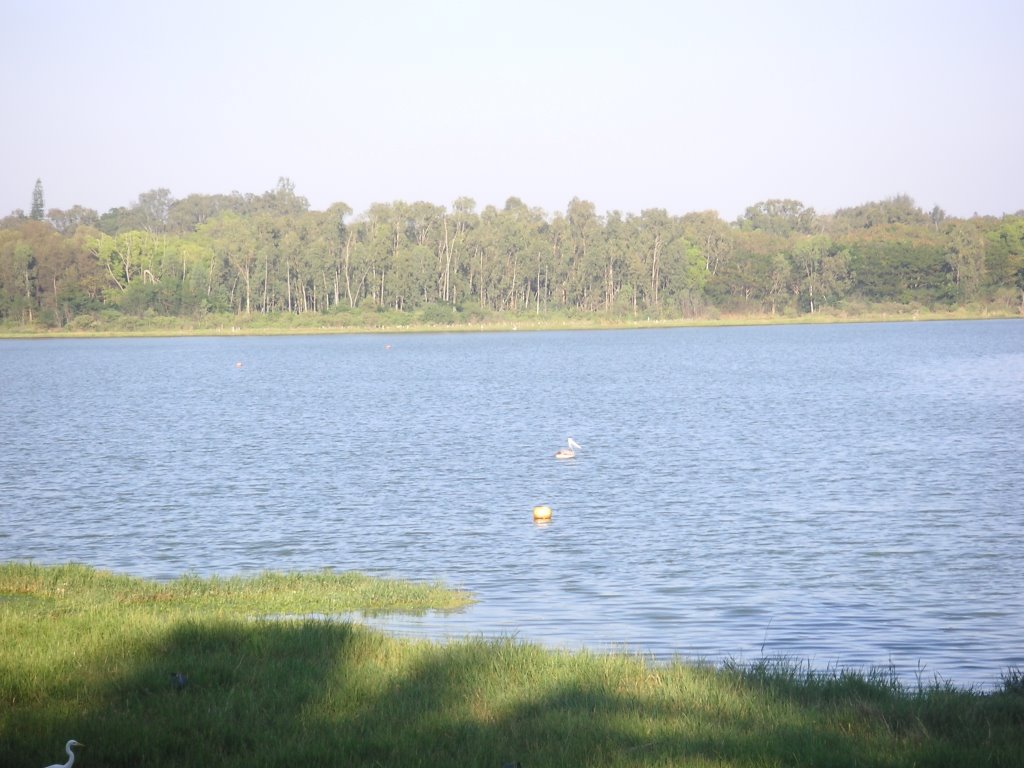
A pelican swimming meditatively in the waters, Kukkarahalli Kere.

A cormorant in the reeds, Kukkarahalli Kere.
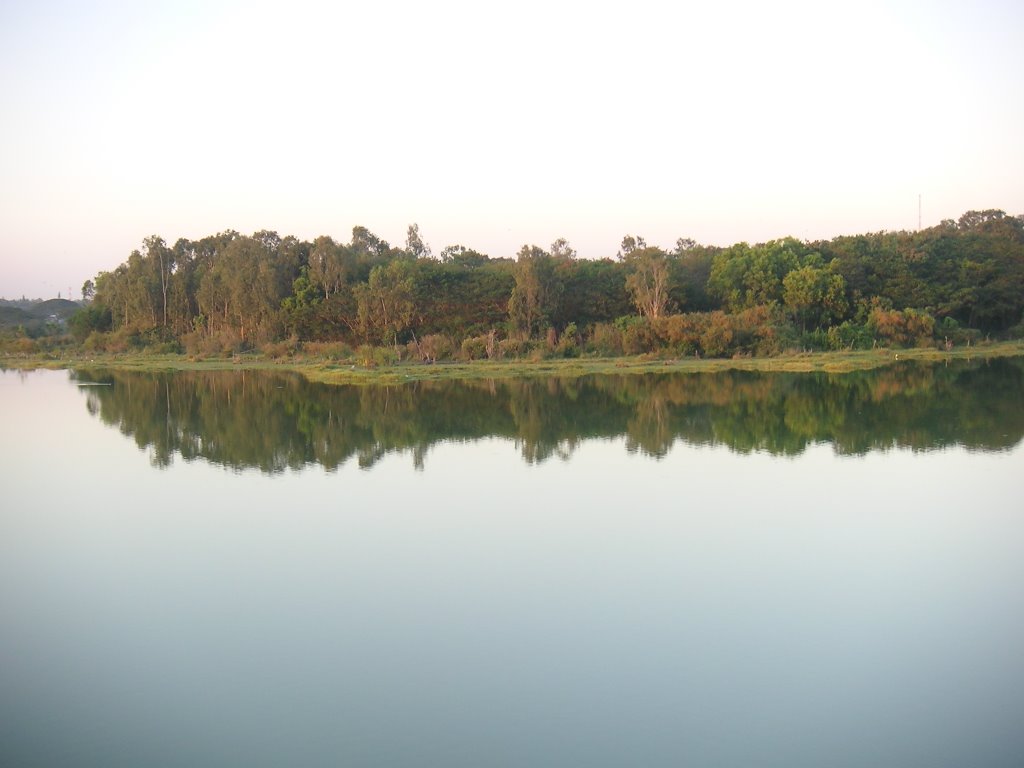
Tranquility, Kukkarahalli Kere.
The rest in the next.
Saturday, January 06, 2007
Of fountain pens.
When in Mysore last week, I saw my grandfather's fountain pen. And I found myself picking it up and admiring it and gushing about how no one uses fountain pens these days and how long it was since I had even set eyes on one.
And that, as usual, took me back to school. How precious fountain pens were! Especially as we had just left "childish" pencils behind, and now were considered old enough to actually write with pens! Though some of us thought that ball point pens were better, we were told to use only fountain pens until our handwriting "gets set".
I remember that mine had a black body and a gold cap, and the nib was a small, elegant, one, not one of those "atrocious" large ones. I took great pleasure in taking upon myself the responsibility of filling ink carefully into the pen, with an ink filler. I loved the colour of the ink in the ink bottle. Rich, dark, blue - Royal Blue, said the name on the bottle - truly royal it was. Of course, I hated the same ink just as much when it got onto my fingers.
A little later, I got a new pen, which did not need an ink filler. It had a mechanism built into the pen itself - you depress the little button at the side, dip the pen into the ink bottle, and let go - and the pen "drank up" the ink. This pen even had a tiny window that told me when the ink in the pen was getting over, and it was time to fill up. In spite of all this, I very often forgot to refill my pen and discovered the slip only after going to school. And then it was time to take the help of the adroit fingers of a friend who would share some of the ink from her pen, by pouring it directly into my pen. For you see, you couldn't borrow fountain pens, because "the nibs took the shape of the inclination of the owner's writing, and if anybody else used it, the nib would split".
When the topic of fountain pens came up, my parents talked about ink wells and blotting papers, both of which were alien to us. Blotting paper, at least, I have laid eyes on some time in my life, but ink wells? Those were ancient! To think they actually had to keep dipping their pens into a bottle of ink to write! [A piece of chalk in our boxes absorbed any accidental leakage of ink from our pens - we had no need for blotting paper].
Fountain pens had lots of other uses too. We had a game in class, where we took a sheet of paper, drew a broad, curved path from point A to point B, and rubbed a piece of candle wax along the path. We then let loose a drop of ink from our pens on the path at point B, and by turning and twisting the paper, we had to bring the drop of ink to point B, without it smudging the paper. The narrower the path, the greater your skill. Needless to say, I was pretty hopeless at it. My expert friends had to get new rough books every week, they tore that many sheets to play this game!
Fountain pens were great weapons too, against unsuspecting classmates and detested teachers. A surreptitious flick of the wrist, and drops of ink settle on the target's back - and the perpetrator could virtually go undetected, because the target doesn't discover the misdeed until much later, unless, of course, someone squealed (and squealers were so quick to be ostracized, that this was a remote possibility).
When we were given permission to graduate to ball point pens, fountain pens were forgotten... I don't even remember where mine went.... but have you noticed, the handwriting is never quite as good as in a dot pen as in a fountain pen.
Now of course, pens themselves seem to be getting outdated - the last time I used a pen was to perhaps sign a cheque or a credit card statement (that might give you an impression that I am very rich, but that would be wrong). Just as I say, "Ink wells? Wasn't that messy?", my grandchildren might ask me, "You actually held something in your fingers and wrote with it? How painful!"....... Who knows?
And that, as usual, took me back to school. How precious fountain pens were! Especially as we had just left "childish" pencils behind, and now were considered old enough to actually write with pens! Though some of us thought that ball point pens were better, we were told to use only fountain pens until our handwriting "gets set".
I remember that mine had a black body and a gold cap, and the nib was a small, elegant, one, not one of those "atrocious" large ones. I took great pleasure in taking upon myself the responsibility of filling ink carefully into the pen, with an ink filler. I loved the colour of the ink in the ink bottle. Rich, dark, blue - Royal Blue, said the name on the bottle - truly royal it was. Of course, I hated the same ink just as much when it got onto my fingers.
A little later, I got a new pen, which did not need an ink filler. It had a mechanism built into the pen itself - you depress the little button at the side, dip the pen into the ink bottle, and let go - and the pen "drank up" the ink. This pen even had a tiny window that told me when the ink in the pen was getting over, and it was time to fill up. In spite of all this, I very often forgot to refill my pen and discovered the slip only after going to school. And then it was time to take the help of the adroit fingers of a friend who would share some of the ink from her pen, by pouring it directly into my pen. For you see, you couldn't borrow fountain pens, because "the nibs took the shape of the inclination of the owner's writing, and if anybody else used it, the nib would split".
When the topic of fountain pens came up, my parents talked about ink wells and blotting papers, both of which were alien to us. Blotting paper, at least, I have laid eyes on some time in my life, but ink wells? Those were ancient! To think they actually had to keep dipping their pens into a bottle of ink to write! [A piece of chalk in our boxes absorbed any accidental leakage of ink from our pens - we had no need for blotting paper].
Fountain pens had lots of other uses too. We had a game in class, where we took a sheet of paper, drew a broad, curved path from point A to point B, and rubbed a piece of candle wax along the path. We then let loose a drop of ink from our pens on the path at point B, and by turning and twisting the paper, we had to bring the drop of ink to point B, without it smudging the paper. The narrower the path, the greater your skill. Needless to say, I was pretty hopeless at it. My expert friends had to get new rough books every week, they tore that many sheets to play this game!
Fountain pens were great weapons too, against unsuspecting classmates and detested teachers. A surreptitious flick of the wrist, and drops of ink settle on the target's back - and the perpetrator could virtually go undetected, because the target doesn't discover the misdeed until much later, unless, of course, someone squealed (and squealers were so quick to be ostracized, that this was a remote possibility).
When we were given permission to graduate to ball point pens, fountain pens were forgotten... I don't even remember where mine went.... but have you noticed, the handwriting is never quite as good as in a dot pen as in a fountain pen.
Now of course, pens themselves seem to be getting outdated - the last time I used a pen was to perhaps sign a cheque or a credit card statement (that might give you an impression that I am very rich, but that would be wrong). Just as I say, "Ink wells? Wasn't that messy?", my grandchildren might ask me, "You actually held something in your fingers and wrote with it? How painful!"....... Who knows?
Wednesday, December 27, 2006
A step towards a better me...
I don't usually make New Year Resolutions. For one, I believe that if I indeed have resolved that I have to do something, I should start immediately and not wait until the new year. Secondly, usually my New Year Resolutions don't even last through January.
But now it has so happened that I have a new resolution - and since it is almost New Year, I have decided to call it my New Year Resolution. One that I am going to make sure doesn't fizzle out.
I have decided to be more systematic, organized and disciplined.
No, please, I am not that hopelessly untidy or disorganized. But there is a lot of scope for improvement. The problem is that I have never felt the need to be that organized, until now.
And to think the people around me are so magnificently orderly. My grandmother. Her Godrej steel almirah. It is such a pleasure to behold it. Her silk sarees neatly folded and placed in hangers - all of them folded to the same dimensions, no protruding ends anywhere. Her cotton sarees folded crisply, placed one above the other, in perfect towers. No Leaning Towers of Pisa here. Her almirah is a study in perfection. She even adds to the effect by placing a bit of sandalwood shaving, or some other sweet-smelling thing in the corners, and when you open the almirah, you get a whiff of the fragrance – such a treat to the senses. Ok, my almirah need not be that faultless. But at least I could have inherited a fraction of that attention to detail? At least as much as to prevent clothes from falling out when the almirah is opened?
Then my mother. She keeps her home and her kitchen spotlessly clean. The furniture is perfectly placed, pots and plants and flowers and curios positioned in strategic places, the bed beautifully made, the cupboards neat and clean, everything in their proper places. When she cooks, there is no trace of it even when she is in the midst of the cooking. She is that meticulous. As for me, you can see vegetable peels and flour everywhere, until I finish and clean up.
My father. Every document, every passbook, cheque book, every bill in place. In neatly arranged folders, in well-maintained and dated files and books. And it is not that he spends unnecessary hours on it. It is just that he is prompt, and precise. If you ask him for a certain something, he will get it for you in a minute. As for me, the less said the better. Check out this conversation, you will get an idea.
Me(calling him up): Papa, is my IOB chequebook with you?
Papa: Let me check. (Half a minute later), No, it must be with you.
Me: Ok, I will check. (There is no question whatsoever of wondering if my father might be wrong, and maybe he has misplaced it).
(After two hours).
Papa: Did you find it?
Me: No I don't think I have it.
Papa: Check again.
(Two days later)
Papa: Did you find it?
Me: No, I looked everywhere, its not there.
Papa: Check again.
(A week later).
Me: Err... ummm... Papa, I found it.
Papa: Where was it?
Me: With my medical bills.
I haven't inherited these qualities from anybody. I could have got at least a bit of it. But no. I have to rely entirely on my own interest and effort to be as systematic as these people mentioned above.
Or I could have picked it up from association. My mom-in-law runs a well-oiled home. All things in their right places all the time, everything done just so. S is also very organized. He knows where his things are, and he keeps records, and maintains files for documents. He is tidy, and dislikes clutter. He thinks he has room for improvement, and while that might be true, it is also true that compared to me, he is a whole world apart. He is distressed by how unorganized I am. He has been trying to bring some improvement in me ever since we got married - but how can he, alone, succeed in such a short time, where my parents, combined, could not for a quarter of a century?
So, I conclude, it has to come from me. From within me. Not for the first time have I realized the need to be organized. But I have comprehended the fact that it has now turned into a necessity.
So, by putting this on my blog, where the whole world (and more importantly, my parents and S) can read it, I am throwing my hat across the fence, so to say. And so, I enter the new year with hope.
A very happy, healthy and peaceful new year to all of you!
But now it has so happened that I have a new resolution - and since it is almost New Year, I have decided to call it my New Year Resolution. One that I am going to make sure doesn't fizzle out.
I have decided to be more systematic, organized and disciplined.
No, please, I am not that hopelessly untidy or disorganized. But there is a lot of scope for improvement. The problem is that I have never felt the need to be that organized, until now.
And to think the people around me are so magnificently orderly. My grandmother. Her Godrej steel almirah. It is such a pleasure to behold it. Her silk sarees neatly folded and placed in hangers - all of them folded to the same dimensions, no protruding ends anywhere. Her cotton sarees folded crisply, placed one above the other, in perfect towers. No Leaning Towers of Pisa here. Her almirah is a study in perfection. She even adds to the effect by placing a bit of sandalwood shaving, or some other sweet-smelling thing in the corners, and when you open the almirah, you get a whiff of the fragrance – such a treat to the senses. Ok, my almirah need not be that faultless. But at least I could have inherited a fraction of that attention to detail? At least as much as to prevent clothes from falling out when the almirah is opened?
Then my mother. She keeps her home and her kitchen spotlessly clean. The furniture is perfectly placed, pots and plants and flowers and curios positioned in strategic places, the bed beautifully made, the cupboards neat and clean, everything in their proper places. When she cooks, there is no trace of it even when she is in the midst of the cooking. She is that meticulous. As for me, you can see vegetable peels and flour everywhere, until I finish and clean up.
My father. Every document, every passbook, cheque book, every bill in place. In neatly arranged folders, in well-maintained and dated files and books. And it is not that he spends unnecessary hours on it. It is just that he is prompt, and precise. If you ask him for a certain something, he will get it for you in a minute. As for me, the less said the better. Check out this conversation, you will get an idea.
Me(calling him up): Papa, is my IOB chequebook with you?
Papa: Let me check. (Half a minute later), No, it must be with you.
Me: Ok, I will check. (There is no question whatsoever of wondering if my father might be wrong, and maybe he has misplaced it).
(After two hours).
Papa: Did you find it?
Me: No I don't think I have it.
Papa: Check again.
(Two days later)
Papa: Did you find it?
Me: No, I looked everywhere, its not there.
Papa: Check again.
(A week later).
Me: Err... ummm... Papa, I found it.
Papa: Where was it?
Me: With my medical bills.
I haven't inherited these qualities from anybody. I could have got at least a bit of it. But no. I have to rely entirely on my own interest and effort to be as systematic as these people mentioned above.
Or I could have picked it up from association. My mom-in-law runs a well-oiled home. All things in their right places all the time, everything done just so. S is also very organized. He knows where his things are, and he keeps records, and maintains files for documents. He is tidy, and dislikes clutter. He thinks he has room for improvement, and while that might be true, it is also true that compared to me, he is a whole world apart. He is distressed by how unorganized I am. He has been trying to bring some improvement in me ever since we got married - but how can he, alone, succeed in such a short time, where my parents, combined, could not for a quarter of a century?
So, I conclude, it has to come from me. From within me. Not for the first time have I realized the need to be organized. But I have comprehended the fact that it has now turned into a necessity.
So, by putting this on my blog, where the whole world (and more importantly, my parents and S) can read it, I am throwing my hat across the fence, so to say. And so, I enter the new year with hope.
A very happy, healthy and peaceful new year to all of you!
Wednesday, December 20, 2006
May The Force not be with you.
I am afflicted with a disease. Or should I call it a bane, an inconvenience? Nothing wrong with my health, thanks for the concern - but there is Something out there that conspires to keep me either too jobless or too busy, with never a balance.
I am not talking about my job. I never talk about it on my blog, not if I can help it. I am referring to my social life. Let me explain.
There are periods in my life when absolutely nothing happens. I go on with my usual activities, my weekends are as usual, and everything is just normal, just short of being boring. Then all of a sudden, on one particular weekend, people decide to have get-togethers and celebrations and parties, and everybody invites me to their event. And that leaves me juggling lunches and brunches and teas and dinners and apologizing to some of them and attending the others, and running around the city and making a mess of the whole thing. Now, why couldn't these people have spread out their events so that they could cover my non-eventful weekends, so that I could attend all the events in peace?
But no. It is almost as if some Unseen Force urges everybody I know to make sure that they arrange events such that Shruthi is caught in a dilemma.
Now, when two events clash, I have 4 options.
1) Attend event A.
2) Attend event B.
3) Attend both events one after another.
4) Attend neither event.
Options 1 and 2 are the most difficult, when it comes to decision-making. All other things being convenient, there are two aspects which aid (or hinder) the decision-making process when it comes to attending an event - Interest and Obligation. Now if an event is both interesting and obligatory for me to attend, there isn't anything much to decide. Just a carefully crafted apology to the other party will do the trick. But the difficulty arises when one is interesting and the other is obligatory. I usually weigh the pros and cons of each and end up going to the - obligatory one. Just once, I went with my heart and went to the interesting event and chucked the obligatory one. I regretted my decision immediately. I found that the interesting event wasn't as interesting as I thought it would be, and I was under a much greater obligation to attend the other event, than I thought I was. If both events are both Interesting and Obligatory, then Importance is the deciding factor. And I won't go into what I do if both are equally important. This could go on and on.
Option 3 is not too difficult if both events are taking place close to each other - I can pop in at both places for a while and get away with it. But if the events are at different corners of the city, I consider my sanity more important, Bangalore traffic being what it is. So this option is out.
Option 4 is silly - but I admit I have taken refuge in it more than once - if not anything else, it gave me a respite from putting my sparse brains to too much work.
Even an event that I arrange is not spared by this Supernatural Force. I happen to call a friend and suggest that we meet up as we haven't done so for a long time, and she agrees and everything is set for Friday at 7 PM. Then on Thursday, you can be sure that another friend will call me and say that she is leaving the city on Saturday and won't be back for two years, and the only time she has is Friday night and can I please meet her then. It pains me to cancel the first date, but it is pretty obvious which one is the more pressing engagement!
My personal plans are also routinely spoiled by this Unknown Agent. For example, when I get over my laziness and schedule a long-overdue visit to the beauty parlour, I can almost look at my phone and predict that someone will call me and say that s/he is in the vicinity and is dropping by to see me, if I am free. It is not like I am going to the doctor or anything - the beauty parlour can wait. So I agree, and convince myself that it is okay to look like Mowgli for one more week.
And reasons. I am a very bad liar, people say, so when I have to tell somebody that I cannot make it to their do, I usually tell the truth - that my presence is required elsewhere. And how do I do it without hurting them? I don't know. I sometimes even add, "Why couldn't you have arranged it last week when I was rotting at home with boredom and yawning till the edges of my mouth needed stitches?"
Oh please please don't stop calling me or inviting me or visiting me, assuming that you are putting me under unnecessary duress. I love meeting you and talking to you and spending time with you. Only please make sure that you are not influenced by The Force when you schedule your events!
I am not talking about my job. I never talk about it on my blog, not if I can help it. I am referring to my social life. Let me explain.
There are periods in my life when absolutely nothing happens. I go on with my usual activities, my weekends are as usual, and everything is just normal, just short of being boring. Then all of a sudden, on one particular weekend, people decide to have get-togethers and celebrations and parties, and everybody invites me to their event. And that leaves me juggling lunches and brunches and teas and dinners and apologizing to some of them and attending the others, and running around the city and making a mess of the whole thing. Now, why couldn't these people have spread out their events so that they could cover my non-eventful weekends, so that I could attend all the events in peace?
But no. It is almost as if some Unseen Force urges everybody I know to make sure that they arrange events such that Shruthi is caught in a dilemma.
Now, when two events clash, I have 4 options.
1) Attend event A.
2) Attend event B.
3) Attend both events one after another.
4) Attend neither event.
Options 1 and 2 are the most difficult, when it comes to decision-making. All other things being convenient, there are two aspects which aid (or hinder) the decision-making process when it comes to attending an event - Interest and Obligation. Now if an event is both interesting and obligatory for me to attend, there isn't anything much to decide. Just a carefully crafted apology to the other party will do the trick. But the difficulty arises when one is interesting and the other is obligatory. I usually weigh the pros and cons of each and end up going to the - obligatory one. Just once, I went with my heart and went to the interesting event and chucked the obligatory one. I regretted my decision immediately. I found that the interesting event wasn't as interesting as I thought it would be, and I was under a much greater obligation to attend the other event, than I thought I was. If both events are both Interesting and Obligatory, then Importance is the deciding factor. And I won't go into what I do if both are equally important. This could go on and on.
Option 3 is not too difficult if both events are taking place close to each other - I can pop in at both places for a while and get away with it. But if the events are at different corners of the city, I consider my sanity more important, Bangalore traffic being what it is. So this option is out.
Option 4 is silly - but I admit I have taken refuge in it more than once - if not anything else, it gave me a respite from putting my sparse brains to too much work.
Even an event that I arrange is not spared by this Supernatural Force. I happen to call a friend and suggest that we meet up as we haven't done so for a long time, and she agrees and everything is set for Friday at 7 PM. Then on Thursday, you can be sure that another friend will call me and say that she is leaving the city on Saturday and won't be back for two years, and the only time she has is Friday night and can I please meet her then. It pains me to cancel the first date, but it is pretty obvious which one is the more pressing engagement!
My personal plans are also routinely spoiled by this Unknown Agent. For example, when I get over my laziness and schedule a long-overdue visit to the beauty parlour, I can almost look at my phone and predict that someone will call me and say that s/he is in the vicinity and is dropping by to see me, if I am free. It is not like I am going to the doctor or anything - the beauty parlour can wait. So I agree, and convince myself that it is okay to look like Mowgli for one more week.
And reasons. I am a very bad liar, people say, so when I have to tell somebody that I cannot make it to their do, I usually tell the truth - that my presence is required elsewhere. And how do I do it without hurting them? I don't know. I sometimes even add, "Why couldn't you have arranged it last week when I was rotting at home with boredom and yawning till the edges of my mouth needed stitches?"
Oh please please don't stop calling me or inviting me or visiting me, assuming that you are putting me under unnecessary duress. I love meeting you and talking to you and spending time with you. Only please make sure that you are not influenced by The Force when you schedule your events!
Tuesday, December 12, 2006
It's all in the name.
It seems to be the season for weddings - and as usual, discussions drifted towards how the marriages happened, and as usual, it took me back to my childhood to that very eventful life of the township I grew up in.
When we were kids, we knew about two kinds of marriages. "Arranged" marriages and "Ooooh" marriages. "Ooooh" meant "Love". Because, back then, "Love" was a taboo word. None of us children even spoke that word out. If anyone did, it was met by a series of "Oooooh"s. I still can't get over the fact that we were such little prudes just a couple of decades ago... and the children of today are familiar with such words, that if I have to use them in my blog, I will have to take the help of special characters.
Anyway, we kids were fascinated with the concept of "Ooooh" marriages, and somehow, peer pressure had convinced us that it was a "Cheee" thing. My mother once scolded my friends and me for such utter silliness, so we stopped saying "Ooooh" for "Love" - when my mom was around.
Well, so, when somebody pointed out that so-and-so had gone through an "Ooooh" marriage, we would look up at the offender with a look that was a mixture of fascination and contempt. This phase lasted just a couple of years, thankfully.
But what were these marriages, anyway? The definition was simple. Arranged marriage was when the parents and relatives scoured the land for a suitable "match" and compared horoscopes and "fixed" the wedding, and the couple dutifully got married.[In later years, the couple had an increasing veto power over thier parents' choice]. Love marriage was when the couple met, liked each other, decided to get married and then told their parents.
But soon I discovered that sub-categories had come up when I was not looking. Like once, when I told Y that X's was a "Love" marriage, and she now lives with her parents-in-law. X looked at me like I had horns growing out of my head.
She said, "How is that possible? It must have been an Arranged marriage."
"Oh no it wasn't. They met at their workplace".
"Then it must be a Love+Arranged marriage".
"And what is that?"
"When the couple falls in love, decide to marry, and tell their parents, and the parents accept and get them married."
"Oh really, and then what happened to the simple Love marriage?"
"That is when a couple fall in love, but the parents are against it, so they get married without the parents' wishes, and it usually involves a break with one or both the set of parents."
"And what if one set of parents is fine with the marriage, and the other set isn't? What is that called?"
"That is still a Love+Arranged marriage, but some explanation has to follow".
Then I met a friend who had got engaged a while ago. I asked him how his fiancee was doing, and he gushed and blushed.
"You know, mine has turned out to be a love marriage".
I was horrified. I had visions of his poor fiancee crying her eyes out when this guy was running off with his "love".
"And how's that?" I asked.
"You know my fiancee, don't you? Our marriage was decided by our elders, but after our engagement, we met very often, and guess what, we have fallen in love! It has turned out to be an Arranged+Love marriage!"
"Hurrah for you! But just out of curiosity, what do you call a marriage which is Arranged, but the couple fall in love after the wedding?"
His face made it clear that he wanted no difficult questions to come in the way of his celebration, so I quickly moved away.
Then there is this other kind of marriage, where a friend of mine and her colleague decided that they enjoyed each other's company, and that since they belonged to the same community, and they had no other love interests, why not raise the issue of a wedding with the elders? So they got their horoscopes matched, and they, well, matched, and they were married. So, I asked no one in particular, what is this marriage called? Technically, it was arranged not by the parents, and technically it wasn't a love marriage. Also, what would have happened if their horoscopes hadn't matched? I received no answer.
Ok here is one more kind for of marriage for you to think about. I know a girl who worked in the city. Her parents, looking out for a "match" for her, asked her to meet a certain someone in the same city, and let them know whether she liked him. But within a couple of days, her parents got some information about the guy's family, which convinced them that it wouldn't be a suitable alliance, so they quickly called her to tell her not to bother about meeting that guy. But this girl had already met him, and hit it off beautifully with him, and she stood her ground that if she would marry, she would marry only him. After a long and painful struggle, she had her way and they got married. So what is this called? "Started-out-arranged-turned-into-love-marriage"?
Other sub-categories are welcome - that is what the comments section is for. This could be a good PhD topic in Sociology, you know....
Update: Viky seems to have already conducted research on this topic, and has left a comment with very detailed classification - you just have to take a look at this!
When we were kids, we knew about two kinds of marriages. "Arranged" marriages and "Ooooh" marriages. "Ooooh" meant "Love". Because, back then, "Love" was a taboo word. None of us children even spoke that word out. If anyone did, it was met by a series of "Oooooh"s. I still can't get over the fact that we were such little prudes just a couple of decades ago... and the children of today are familiar with such words, that if I have to use them in my blog, I will have to take the help of special characters.
Anyway, we kids were fascinated with the concept of "Ooooh" marriages, and somehow, peer pressure had convinced us that it was a "Cheee" thing. My mother once scolded my friends and me for such utter silliness, so we stopped saying "Ooooh" for "Love" - when my mom was around.
Well, so, when somebody pointed out that so-and-so had gone through an "Ooooh" marriage, we would look up at the offender with a look that was a mixture of fascination and contempt. This phase lasted just a couple of years, thankfully.
But what were these marriages, anyway? The definition was simple. Arranged marriage was when the parents and relatives scoured the land for a suitable "match" and compared horoscopes and "fixed" the wedding, and the couple dutifully got married.[In later years, the couple had an increasing veto power over thier parents' choice]. Love marriage was when the couple met, liked each other, decided to get married and then told their parents.
But soon I discovered that sub-categories had come up when I was not looking. Like once, when I told Y that X's was a "Love" marriage, and she now lives with her parents-in-law. X looked at me like I had horns growing out of my head.
She said, "How is that possible? It must have been an Arranged marriage."
"Oh no it wasn't. They met at their workplace".
"Then it must be a Love+Arranged marriage".
"And what is that?"
"When the couple falls in love, decide to marry, and tell their parents, and the parents accept and get them married."
"Oh really, and then what happened to the simple Love marriage?"
"That is when a couple fall in love, but the parents are against it, so they get married without the parents' wishes, and it usually involves a break with one or both the set of parents."
"And what if one set of parents is fine with the marriage, and the other set isn't? What is that called?"
"That is still a Love+Arranged marriage, but some explanation has to follow".
Then I met a friend who had got engaged a while ago. I asked him how his fiancee was doing, and he gushed and blushed.
"You know, mine has turned out to be a love marriage".
I was horrified. I had visions of his poor fiancee crying her eyes out when this guy was running off with his "love".
"And how's that?" I asked.
"You know my fiancee, don't you? Our marriage was decided by our elders, but after our engagement, we met very often, and guess what, we have fallen in love! It has turned out to be an Arranged+Love marriage!"
"Hurrah for you! But just out of curiosity, what do you call a marriage which is Arranged, but the couple fall in love after the wedding?"
His face made it clear that he wanted no difficult questions to come in the way of his celebration, so I quickly moved away.
Then there is this other kind of marriage, where a friend of mine and her colleague decided that they enjoyed each other's company, and that since they belonged to the same community, and they had no other love interests, why not raise the issue of a wedding with the elders? So they got their horoscopes matched, and they, well, matched, and they were married. So, I asked no one in particular, what is this marriage called? Technically, it was arranged not by the parents, and technically it wasn't a love marriage. Also, what would have happened if their horoscopes hadn't matched? I received no answer.
Ok here is one more kind for of marriage for you to think about. I know a girl who worked in the city. Her parents, looking out for a "match" for her, asked her to meet a certain someone in the same city, and let them know whether she liked him. But within a couple of days, her parents got some information about the guy's family, which convinced them that it wouldn't be a suitable alliance, so they quickly called her to tell her not to bother about meeting that guy. But this girl had already met him, and hit it off beautifully with him, and she stood her ground that if she would marry, she would marry only him. After a long and painful struggle, she had her way and they got married. So what is this called? "Started-out-arranged-turned-into-love-marriage"?
Other sub-categories are welcome - that is what the comments section is for. This could be a good PhD topic in Sociology, you know....
Update: Viky seems to have already conducted research on this topic, and has left a comment with very detailed classification - you just have to take a look at this!
Thursday, November 30, 2006
Open to the elements!
One of my favourite subjects when I studied Energy Engineering, was Energy Efficient Buildings. These are just buildings that are built in such a way that artificial energy requirements are minimised. This is done by designing the house such that it makes optimum use of naturally available light and air, and you need not rely on artificial lighting and cooling. The materials that you use to build the house also matters.
Actually, our ancestors knew perfectly well how to build energy efficient homes. If you walk in from the hot sweltering sun into an old house with a courtyard, your face is greeted with a cool breeze, and your feet tread upon a deliciously cool floor. Where does this coolness come in on this hot day? Just a little planning and design.
And now we have lost it. For as usual, we are aping the west. The sleek glass buildings that we see so much, that look so posh and sophisticated and appealing are perfectly suited to the western climate. The glass windows are excellent absorbers of heat, and the building is automatically heated, thus reducing their heating requirements in winter. But in a tropical climate like ours, it only serves to heat up the interiors further, which we then try to counter by pumping in precious energy to power the air conditioners. So, due to glass windows, now the air conditioners have to do the work of reducing temp from 35 deg to 24 deg, rather than 28 to 24 deg (In summer, in Bangalore). And when there are power cuts, the problem could have been solved by simply opening the windows - but ah no, the windows here cannot be opened. So you have a backup of diesel generators which results in more energy wastage.
Building such energy guzzling buildings in a place like India is almost as silly as building an igloo in a desert.
If you want an example of an Energy Efficient Building, visit the office of The Energy Research Institute in Bangalore, very near Airport Road in Domlur. They have constructed the building in such a way that artificial lighting is not necessary at all. As far as I could make out, there was no air conditioning either, and no fans. Yet, there was a lot of air movement, and a cool, pleasant atmosphere. One more specialty of this place is that this building stands next to an open drain, the smell from which hits you when you go past it. But inside the building, there is no hint of a stink. You can get an idea about how it was accomplished, here.
And building such buildings is not expensive either. You just need an architect and an engineer who know the basics. But renovation or modification of an existing building to become energy efficient can be expensive.
Even our department in our college was built with these principles. The college is situated in an extremely hot place. Even then, we did not need to switch on fans even if the temperatures outside were 30-35 deg. Only when it went to 40 deg, did we switch on the fans. As for lights, even on the cloudiest day, we haven't switched on the lights in our classrooms. In fact, I wouldn't even have known where the light switches were, had we not had special classes in the evening by a visiting professor!
To give you a slight idea of the type of construction and materials used -
1) The South and West facing walls, which experience maximum solar radiation, had no classrooms or windows, but were covered with granite, which doesn't absorb heat, instead creates a cooling effect
2) The building had a courtyard, with classrooms all around... and a courtyard is perhaps the best design to create cool breezes.
3) The walls had insulating materials between bricks, which again minimized heat absorption.
4) The floor of the terrace, again, was specially constructed such that heat is not absorbed.
There is a lot of information available on the internet too, if you are interested to look. But when reading up on principles, you should remember that the principles change with the place and latitude. What might be a perfectly good design in Australia, will be totally useless in India because the angle of the solar radiation is totally different in the two hemispheres. Similarly, even a building in Bangalore (moderate climate) will be different from one in, say, New Delhi (extreme climatic conditions). Our department building was designed for a very hot climate, so it concentrated on minimising heat absorption.
Design of a building is one step - the next step involves using energy efficient light fixtures, etc. The third step involves incorporating solar water heating, and solar photovoltaics for taking care of a part of the energy requirements of the building - all these make up an energy efficient building.
And the best part of such a building is that it is a pleasure to be in it - it creates the effect of lots of space - it looks beautiful. In fact, schools should be specially designed with these principles in mind - a lot of light and air is conducive to learning.
So, if you are going to build a house, do give this a thought, will you? :)
Actually, our ancestors knew perfectly well how to build energy efficient homes. If you walk in from the hot sweltering sun into an old house with a courtyard, your face is greeted with a cool breeze, and your feet tread upon a deliciously cool floor. Where does this coolness come in on this hot day? Just a little planning and design.
And now we have lost it. For as usual, we are aping the west. The sleek glass buildings that we see so much, that look so posh and sophisticated and appealing are perfectly suited to the western climate. The glass windows are excellent absorbers of heat, and the building is automatically heated, thus reducing their heating requirements in winter. But in a tropical climate like ours, it only serves to heat up the interiors further, which we then try to counter by pumping in precious energy to power the air conditioners. So, due to glass windows, now the air conditioners have to do the work of reducing temp from 35 deg to 24 deg, rather than 28 to 24 deg (In summer, in Bangalore). And when there are power cuts, the problem could have been solved by simply opening the windows - but ah no, the windows here cannot be opened. So you have a backup of diesel generators which results in more energy wastage.
Building such energy guzzling buildings in a place like India is almost as silly as building an igloo in a desert.
If you want an example of an Energy Efficient Building, visit the office of The Energy Research Institute in Bangalore, very near Airport Road in Domlur. They have constructed the building in such a way that artificial lighting is not necessary at all. As far as I could make out, there was no air conditioning either, and no fans. Yet, there was a lot of air movement, and a cool, pleasant atmosphere. One more specialty of this place is that this building stands next to an open drain, the smell from which hits you when you go past it. But inside the building, there is no hint of a stink. You can get an idea about how it was accomplished, here.
And building such buildings is not expensive either. You just need an architect and an engineer who know the basics. But renovation or modification of an existing building to become energy efficient can be expensive.
Even our department in our college was built with these principles. The college is situated in an extremely hot place. Even then, we did not need to switch on fans even if the temperatures outside were 30-35 deg. Only when it went to 40 deg, did we switch on the fans. As for lights, even on the cloudiest day, we haven't switched on the lights in our classrooms. In fact, I wouldn't even have known where the light switches were, had we not had special classes in the evening by a visiting professor!
To give you a slight idea of the type of construction and materials used -
1) The South and West facing walls, which experience maximum solar radiation, had no classrooms or windows, but were covered with granite, which doesn't absorb heat, instead creates a cooling effect
2) The building had a courtyard, with classrooms all around... and a courtyard is perhaps the best design to create cool breezes.
3) The walls had insulating materials between bricks, which again minimized heat absorption.
4) The floor of the terrace, again, was specially constructed such that heat is not absorbed.
There is a lot of information available on the internet too, if you are interested to look. But when reading up on principles, you should remember that the principles change with the place and latitude. What might be a perfectly good design in Australia, will be totally useless in India because the angle of the solar radiation is totally different in the two hemispheres. Similarly, even a building in Bangalore (moderate climate) will be different from one in, say, New Delhi (extreme climatic conditions). Our department building was designed for a very hot climate, so it concentrated on minimising heat absorption.
Design of a building is one step - the next step involves using energy efficient light fixtures, etc. The third step involves incorporating solar water heating, and solar photovoltaics for taking care of a part of the energy requirements of the building - all these make up an energy efficient building.
And the best part of such a building is that it is a pleasure to be in it - it creates the effect of lots of space - it looks beautiful. In fact, schools should be specially designed with these principles in mind - a lot of light and air is conducive to learning.
So, if you are going to build a house, do give this a thought, will you? :)
Wednesday, November 29, 2006
A reco.
I will be back with some posts, but I couldn't resist telling you about this very funny blogger - Raj of Plus Ultra. I have been reading his blog for over a year and he has only been getting better.
It is not that there are no other blogs on my blogroll that are worth mentioning. But the fact is that I feel that considering how good Raj of Plus Ultra is, he is not read by a proportionate number of readers. And when I see some other moderately funny bloggers praised to the skies, I keep saying in my mind, "But you haven't read Plus Ultra!" So I decided to bring the voice out of my head onto my blog -- this is my tiny attempt at publicity for him. And no, he is not giving me any commission for this. Just a fan's attempt to thank someone who always makes her smile!
It is not that there are no other blogs on my blogroll that are worth mentioning. But the fact is that I feel that considering how good Raj of Plus Ultra is, he is not read by a proportionate number of readers. And when I see some other moderately funny bloggers praised to the skies, I keep saying in my mind, "But you haven't read Plus Ultra!" So I decided to bring the voice out of my head onto my blog -- this is my tiny attempt at publicity for him. And no, he is not giving me any commission for this. Just a fan's attempt to thank someone who always makes her smile!
Saturday, November 25, 2006
Published!
Succumbing to the insistence of my dear well-wishers and pushers, I sent along a little something to Deccan Herald, and it has been published in today's edition (Nov 25th, 2006), in their "Right in the Middle" section.
They haven't edited anything except for the very last line, which they have modified to mean the exact opposite of what I wrote originally!
You can read it online here.
They haven't edited anything except for the very last line, which they have modified to mean the exact opposite of what I wrote originally!
You can read it online here.
Tuesday, November 21, 2006
Akashvani Sangeet Sammelan - Broadcast Schedule
The Akashvani Sangeet Sammelan is an annual festival of music, conducted by All India Radio. Every year, since 1954, it has been broadcasting concerts of known and upcoming artistes as part of this festival.
This is something I look forward to each year, a veritable feast for the soul. Every night for about a month in December, I go to sleep with the strains of beautiful music in my ears - and what could be more relaxing?
This year, the broadcast starts on December 2nd, 2006.
Everytime I get comfortable in the feeling that the whole world is getting net-savvy, there comes a rude realization that it is not yet so. An example in the present context is that I couldn't find the Broadcast Schedule of the Sangeet Sammelan anywhere on the net.
I finally found a handbook of AIR, which gives the entire schedule, and as my own little contribution to the music lovers of India, I have typed out the entire schedule, along with the dates, time, and categories.
Do tune in, and hope you enjoy it!
AKASHVANI SANGEET SAMMELAN - 2006
BROADCAST SCHEDULE
[K-KARNATIC, H-HINDUSTANI]
[Source: All India Radio Booklet (typed out with some corrections).]
This is something I look forward to each year, a veritable feast for the soul. Every night for about a month in December, I go to sleep with the strains of beautiful music in my ears - and what could be more relaxing?
This year, the broadcast starts on December 2nd, 2006.
Everytime I get comfortable in the feeling that the whole world is getting net-savvy, there comes a rude realization that it is not yet so. An example in the present context is that I couldn't find the Broadcast Schedule of the Sangeet Sammelan anywhere on the net.
I finally found a handbook of AIR, which gives the entire schedule, and as my own little contribution to the music lovers of India, I have typed out the entire schedule, along with the dates, time, and categories.
Do tune in, and hope you enjoy it!
AKASHVANI SANGEET SAMMELAN - 2006
BROADCAST SCHEDULE
| DATE | DAY | TIME | ARTIST | CATEGORY | K/H |
|---|---|---|---|---|---|
| 2/12/2006 | Saturday | 9.30-11 pm | Veena Sahasrabuddhe | Vocal | H |
| 4/12/2006 | Monday | 10-11 pm | Jayanthi Kumaresh | Veena | K |
| 5/12/2006 | Tuesday | 10-11 pm | Barun Kumar Pal | Guitar | H |
| 6/12/2006 | Wednes- day | 10-11 pm | Madhav Gudi | Vocal | H |
| 7/12/2006 | Thursday | 10-11 pm | Trichur V. Ramachandran | Vocal | K |
| 8/12/2006 | Friday | 10-11 pm | Arvind Parikh | Sitar | H |
| 9/12/2006 | Saturday | 9.30-10.30 pm | Afroz Bano | Light Classical Vocal | H |
| 9/12/2006 | Saturday | 10.30-11 pm | Nissar Hussain Khan | Tabla | H |
| 10/12/2006 | Sunday | 10-11 am | H.C.Verma | Vocal | H |
| 10/12/2006 | Sunday | 11-12 noon | Nityanand Haldipur | Flute | H |
| 10/12/2006 | Sunday | 9 30 –11 pm | Kunnakkudi R.Vaidyanathan | Violin | K |
| 11/12/2006 | Monday | 10-11 pm | Vijaya Jadhav | Vocal | H |
| 12/12/2006 | Tuesday | 10-11 pm | Rajendra Prasanna | Flute | H |
| 13/12/2006 | Wednes- day | 10-11 pm | Vishakha Hari | Vocal | K |
| 14/12/2006 | Thursday | 10-11 pm | Alka Deo Marulkar | Vocal | H |
| 15/12/2006 | Friday | 10-11 pm | Amarnath Mishra | Sitar | H |
| 16/12/2006 | Saturday | 9 30 – 11 pm | N.Ramani | Flute | K |
| 17/12/2006 | Sunday | 9 30 –11 pm | Ustad Mazhar Ali and Javaad Ali Khan | Vocal Duet | H |
| 18/12/2006 | Monday | 10-11 pm | Niladri Kumar | Sitar | H |
| 19/12/2006 | Tuesday | 10-11 pm | Cheppad A.E Vamanan Namboodiri | Vocal | K |
| 20/12/2006 | Wednes- day | 10-11 pm | Shanti Sharma | Vocal | H |
| 21/12/2006 | Thursday | 10-11 pm | Basant Kabra | Sarod | H |
| 22/12/2006 | Friday | 10-11 pm | Chittoor G.Venkateshan | Flute | K |
| 23/12/2006 | Saturday | 9 30-11 pm | AbhayNarayan Mallick | Dhrupad- Dhamar | H |
| 24/12/2006 | Sunday | 10-11 am | Bharat Bhushan Goswami | Sarangi | H |
| 24/12/2006 | Sunday | 11-12 noon | Baldevraj Verma | Vocal | H |
| 24/12/2006 | Sunday | 9 30-11 pm | N.Ravikiran | Chitraveena | K |
| 25/12/2006 | Monday | 10-11 pm | Mambalam Sisters | Vocal | K |
| 26/12/2006 | Tuesday | 10-11 pm | Dinkar Panshikar | Vocal | H |
| 27/12/2006 | Wednes- day | 10-11 pm | Praveen Shevlikar | Violin | H |
| 28/12/2006 | Thursday | 10-11 pm | Kalyani Lakshminarayana | Veena | K |
| 29/12/2006 | Friday | 10-11 pm | Nisha Parasnis | Vocal | H |
| 30/12/2006 | Saturday | 9 30-11 pm | Buddhadeb Dasgupta | Sarod | H |
| 1/1/2007 | Monday | 10-11 pm | Desur D.S.D.Selvarathinam | Nagaswaram | K |
| 2/1/2007 | Tuesday | 10-11 pm | Shubhra Guha | Vocal | H |
| 3/1/2007 | Wednes- day | 10-11 pm | Bahauddin Dagar | Rudraveena | H |
| 4/1/2007 | Thursday | 10-11 pm | T.V. Shankaranarayana | Vocal | K |
| 5/1/2007 | Friday | 10-11 pm | Vishwanath | Vocal | H |
| 6/1/2007 | Saturday | 9 30 – 10 30 pm | Samaresh Choudhury | Vocal | H |
| 6/1/2007 | Saturday | 10 30-11 pm | Radheshyam Sharma | Pakhawaj | H |
| 7/1/2007 | Sunday | 9 30-11 pm | Bombay sisters | Vocal | K |
| 8/1/2007 | Monday | 10-11 pm | Sandipan Samajpati | Vocal | H |
| 9/1/2007 | Tuesday | 10-11 pm | Saumitra Lahiri | Sitar | H |
| 10/1/2007 | Wednes- day | 10-11 pm | M. Chandrashekharan | Violin | K |
[K-KARNATIC, H-HINDUSTANI]
[Source: All India Radio Booklet (typed out with some corrections).]
Sunday, November 19, 2006
It's a long way to Tipperary......
TP Kailasam is one of Karnataka's better-known humorists. Though he passed away about sixty years ago, he is remembered quite often even now in many contexts. A host of delightful stories, anecdotes and witticisms are attributed to him.
He was a very interesting person. He reportedly could blow smoke rings and spell out his name with them. How cool is that! (I mean, not his smoking, you know what I mean!) He was a master punster, and often refered to himself as "Typical Ass".
Most anecdotes are best told and understood in Kannada, but here is one interesting story. Once, while Gandhiji was staying for a while at Nandi Hills, there was a concert by the great violinist T.Chowdaiah. Gandhiji, enjoying the magnificent music, turned to Kailasam, who sat next to him, and asked, "Who is this great man?" Immediately, Kailasam replied, "Oh, Bapuji, you are a great non-violinist, but this Chowdaiah is a pakka violinist!" He was rewarded with a wide toothless grin.
On another occasion, somebody asked Kailasam, "You say that Sir M.Vishweshwaraiah is blessed with sixth sense, does that mean that nobody else has sixth sense?" Kailasam replied, "Oh sure, you do have it too, but in your case it is called non-sense."
Anyway, this space will not suffice if I begin to relate his anecdotes, so let's leave it at that.
Recently, I had been to a wedding reception, where there was a live Sugama Sangeeta (Kannada Light Music) concert. I did not recognize the male singer, but the female singer was the gorgeous M.D.Pallavi (I know her better as Vidya of Mayamriga fame).
[Sidenote: In Mayamriga (A popular Kannada soap directed by TN Seetharam, that was aired a few years ago), Pallavi played the role of Vidya, a singer, who walked with a limp. During this concert at the wedding, at one point, Pallavi changed her sitting position, and as she did so, she gave a slight grimace and rubbed her foot. The first thought that popped into my head was, "Oh, her bad leg must be giving her trouble... ". Even as I started thinking this, I realized what I was doing... "Oh man", I thought, "That was just in the serial.......... Pallavi's leg, in reality, is just fine..." If I, who hardly watched a dozen episodes of Mayamriga, could get so attuned to her reel personality, then what about those people who watch soaps with total dedication? Reminded me of this post of mine. End of sidenote.]
So, during the concert, the male singer sang the song "Namma Tipparhalli Balu Doora". I remembered it as a song I had loved as a child, but had long forgotten it. I was thrilled to listen to it after all these years. I vaguely remembered that it was composed by TP Kailasam. This, and another song, "Kolikeranga", had been two of my favourites.
"Kolikeranga" is a spoof of the English poem "Constantinople". The story goes that when Kailasam was studying in London, an English friend of his sang "Constantinople", and claimed that this kind of a song cannot be composed in any other language. And Kailasam, as a challenge, composed "Kolikeranga" right on the spot.
I googled and found that even "Namma Tipparhalli Balu Doora" is a spoof of an English marching song, "It's a long way to Tipperary".
You can listen to both these songs, sung by C.Ashwath, a well-known singer in Kannada, here.
Both these songs have the first few lines of the English original, and then the Kannada version, as a continuation. Do listen to them. The English original "It's a long way to Tipperary", is such a beautiful, evocative song... full of old-world charm. I just fell in love with it.
And if you are a Kannadiga, do concentrate on the lyrics of the Kannada versions - they are hilarious. And if you don't catch the lyrics, you can find them here. Hope you enjoy them as much as I did!
And here's to more such accidental discoveries!
He was a very interesting person. He reportedly could blow smoke rings and spell out his name with them. How cool is that! (I mean, not his smoking, you know what I mean!) He was a master punster, and often refered to himself as "Typical Ass".
Most anecdotes are best told and understood in Kannada, but here is one interesting story. Once, while Gandhiji was staying for a while at Nandi Hills, there was a concert by the great violinist T.Chowdaiah. Gandhiji, enjoying the magnificent music, turned to Kailasam, who sat next to him, and asked, "Who is this great man?" Immediately, Kailasam replied, "Oh, Bapuji, you are a great non-violinist, but this Chowdaiah is a pakka violinist!" He was rewarded with a wide toothless grin.
On another occasion, somebody asked Kailasam, "You say that Sir M.Vishweshwaraiah is blessed with sixth sense, does that mean that nobody else has sixth sense?" Kailasam replied, "Oh sure, you do have it too, but in your case it is called non-sense."
Anyway, this space will not suffice if I begin to relate his anecdotes, so let's leave it at that.
Recently, I had been to a wedding reception, where there was a live Sugama Sangeeta (Kannada Light Music) concert. I did not recognize the male singer, but the female singer was the gorgeous M.D.Pallavi (I know her better as Vidya of Mayamriga fame).
[Sidenote: In Mayamriga (A popular Kannada soap directed by TN Seetharam, that was aired a few years ago), Pallavi played the role of Vidya, a singer, who walked with a limp. During this concert at the wedding, at one point, Pallavi changed her sitting position, and as she did so, she gave a slight grimace and rubbed her foot. The first thought that popped into my head was, "Oh, her bad leg must be giving her trouble... ". Even as I started thinking this, I realized what I was doing... "Oh man", I thought, "That was just in the serial.......... Pallavi's leg, in reality, is just fine..." If I, who hardly watched a dozen episodes of Mayamriga, could get so attuned to her reel personality, then what about those people who watch soaps with total dedication? Reminded me of this post of mine. End of sidenote.]
So, during the concert, the male singer sang the song "Namma Tipparhalli Balu Doora". I remembered it as a song I had loved as a child, but had long forgotten it. I was thrilled to listen to it after all these years. I vaguely remembered that it was composed by TP Kailasam. This, and another song, "Kolikeranga", had been two of my favourites.
"Kolikeranga" is a spoof of the English poem "Constantinople". The story goes that when Kailasam was studying in London, an English friend of his sang "Constantinople", and claimed that this kind of a song cannot be composed in any other language. And Kailasam, as a challenge, composed "Kolikeranga" right on the spot.
I googled and found that even "Namma Tipparhalli Balu Doora" is a spoof of an English marching song, "It's a long way to Tipperary".
You can listen to both these songs, sung by C.Ashwath, a well-known singer in Kannada, here.
Both these songs have the first few lines of the English original, and then the Kannada version, as a continuation. Do listen to them. The English original "It's a long way to Tipperary", is such a beautiful, evocative song... full of old-world charm. I just fell in love with it.
And if you are a Kannadiga, do concentrate on the lyrics of the Kannada versions - they are hilarious. And if you don't catch the lyrics, you can find them here. Hope you enjoy them as much as I did!
And here's to more such accidental discoveries!
Monday, November 13, 2006
James and James
So India is planning a Manned Spaceflight program. Coincidentally, this news came at just the time I was finishing a magnificent book, "Space", by James Michener, in which he writes about America's space mission. The key word in the plans about India's space mission is, to do it "ahead of China". And the keyword in America's space program was to put a man on the moon "ahead of Russia", who had already sent a man to space. Interesting!
I have gushed about James Michener earlier in these pages. But that will not stop me from gushing again.
Michener's books are unique. He chooses a subject, does extensive research on it, and then writes a story about it. The result? You get all the information about that subject, in the form of a gripping story.
All books I had read so far involved countries. For example, in Hawaii, Michener traces the history of Hawaii right from its formation, to the first dwellers, through the centuries to the present. His facts are correct, historical details are factual. But he makes a story out of it. Instead of telling you, "Hawaii's first inhabitants were people of blah-blah origin", he brings to life a family, with its own joys and sorrows, and makes that family migrate to Hawaii. He writes about the family, its experience and travails, and then moves a century forward and writes about the grandson of the family he had talked about previously. He traces the developments of the habits and culture of Hawaii through these jumps in time. Sometimes, in the regular dealings of these people, he pops in a real historical character, like a scientist, or a national leader, and gives him a role too in the story. So it hits you from time to time, that what you are reading might be a fictitious story, but somewhere, such a thing must surely have happened to somebody.
So ultimately what you are reading is a engrossing story about one or two families. But what you are absorbing is the entire history and culture of Hawaii. I mean, could it get better?
Another mind-blowing book is The Source, which creates the same magic with the land of Israel. Hawaii and Source are my favourites, but the others are no less magnificent. Covenant(About S.Africa), Poland, etc. There are a lot more short stories which I haven't read yet, and some books like Caravans(about Afghanistan) and Sayonara(about Japan), which are short novels that just give you a story, but Michener doesn't miss sprinkling it with large doses of culture and history.
Space is the first "non-country-centric" kind of book I read - it traces the beginnings of interest in Space missions, starting from the Second World War. It tells you everything that you need to know about what goes into a Space Mission, by means of stories of half a dozen exceptional men. Wow, what a book!
You come out of reading any book of his, with a sense of fulfilment.
The other James couldn't be more different. James Herriot. The much-loved author who wrote about his hysterically funny experiences as a countryside veterinarian.
The first book of his that I read was his first book, If Only They Could Talk, and he had me hooked right from page one. This book is about the first year of his veterinary practice, and he starts the book with how he has been called in the middle of the night to attend to a cow which has been in labour for a long time, but hasn't delivered the calf yet. So, says Herriott, he was knee-deep in cow muck, in the dirty shed in the middle of the cold night, with his entire arm inside the cow, trying to feel the calf, and then he thinks of the picture in his course books, which dealt with calving, and wonders at how different the picture was. He says, in his own words -
Ah, such joy!
The feeling you get after reading James Herriot is one of "Nirmal Anand" (Pure Joy) (Now which movie is this phrase from?)
While Michener needs to be read with concentration, and can get heavy at times (Pleasantly heavy - never a dull moment), Herriot gives you hours of laughter. Herriott's books are probably the only ones that have made me put the book down and clutch my stomach and laugh. And while I would recommend Michener only to the "Vidya Arthis" (those who seek knowledge), I would recommend Herriot to everybody looking for some hours of pleasant reading - yes, even you, who says "Ohhhh I can't read even one page of a novel". Because it is light, it is fun, and you require no effort at all. And it is always lovely to read an affectionate account of those loveable creatures that we call animals.
So, whenever anybody asks me who my fave novelist is, it is quite simple for me to answer. "James, and James"!
I have gushed about James Michener earlier in these pages. But that will not stop me from gushing again.
Michener's books are unique. He chooses a subject, does extensive research on it, and then writes a story about it. The result? You get all the information about that subject, in the form of a gripping story.
All books I had read so far involved countries. For example, in Hawaii, Michener traces the history of Hawaii right from its formation, to the first dwellers, through the centuries to the present. His facts are correct, historical details are factual. But he makes a story out of it. Instead of telling you, "Hawaii's first inhabitants were people of blah-blah origin", he brings to life a family, with its own joys and sorrows, and makes that family migrate to Hawaii. He writes about the family, its experience and travails, and then moves a century forward and writes about the grandson of the family he had talked about previously. He traces the developments of the habits and culture of Hawaii through these jumps in time. Sometimes, in the regular dealings of these people, he pops in a real historical character, like a scientist, or a national leader, and gives him a role too in the story. So it hits you from time to time, that what you are reading might be a fictitious story, but somewhere, such a thing must surely have happened to somebody.
So ultimately what you are reading is a engrossing story about one or two families. But what you are absorbing is the entire history and culture of Hawaii. I mean, could it get better?
Another mind-blowing book is The Source, which creates the same magic with the land of Israel. Hawaii and Source are my favourites, but the others are no less magnificent. Covenant(About S.Africa), Poland, etc. There are a lot more short stories which I haven't read yet, and some books like Caravans(about Afghanistan) and Sayonara(about Japan), which are short novels that just give you a story, but Michener doesn't miss sprinkling it with large doses of culture and history.
Space is the first "non-country-centric" kind of book I read - it traces the beginnings of interest in Space missions, starting from the Second World War. It tells you everything that you need to know about what goes into a Space Mission, by means of stories of half a dozen exceptional men. Wow, what a book!
You come out of reading any book of his, with a sense of fulfilment.
The other James couldn't be more different. James Herriot. The much-loved author who wrote about his hysterically funny experiences as a countryside veterinarian.
The first book of his that I read was his first book, If Only They Could Talk, and he had me hooked right from page one. This book is about the first year of his veterinary practice, and he starts the book with how he has been called in the middle of the night to attend to a cow which has been in labour for a long time, but hasn't delivered the calf yet. So, says Herriott, he was knee-deep in cow muck, in the dirty shed in the middle of the cold night, with his entire arm inside the cow, trying to feel the calf, and then he thinks of the picture in his course books, which dealt with calving, and wonders at how different the picture was. He says, in his own words -
"The didn't say anything about this in the (course) book, I thought, as the snow blew in through the gaping doorway and settled on my naked back.
…
My mind went back to that picture in the obstetrics book. A cow standing in the middle of a gleaming floor while a sleek veterinary surgeon in a spotless parturition overall inserted his arm to a polite distance. He was relaxed and smiling, the farmer and his helpers were smiling, even the cow was smiling.
Ah, such joy!
The feeling you get after reading James Herriot is one of "Nirmal Anand" (Pure Joy) (Now which movie is this phrase from?)
While Michener needs to be read with concentration, and can get heavy at times (Pleasantly heavy - never a dull moment), Herriot gives you hours of laughter. Herriott's books are probably the only ones that have made me put the book down and clutch my stomach and laugh. And while I would recommend Michener only to the "Vidya Arthis" (those who seek knowledge), I would recommend Herriot to everybody looking for some hours of pleasant reading - yes, even you, who says "Ohhhh I can't read even one page of a novel". Because it is light, it is fun, and you require no effort at all. And it is always lovely to read an affectionate account of those loveable creatures that we call animals.
So, whenever anybody asks me who my fave novelist is, it is quite simple for me to answer. "James, and James"!
Subscribe to:
Posts (Atom)
 -
-